My heavily used, heavily replenished Xtol that was first mixed in 2021 delivers quasi-linear results from:
25 minutes at 12 Celcius to 2minutes 45 seconds at 34 Celcius. I haven't tested outside those limits.
All black and white films, whatever the type (ok, not lith), whatever the speed, go into development for a time determined by the time vs temperature chart.
Negative densities are well matched by giving each film its own individual exposure index prior to exposure, as established by testing.
Negative contrasts come out reasonably close.
How can this work? I think ancient Xtol , active but of unknown composition, becomes a particularly "forgiving" developer.
Minor shifts in density and contrast are easily accommodated by modern variable contrast enlarging paper.
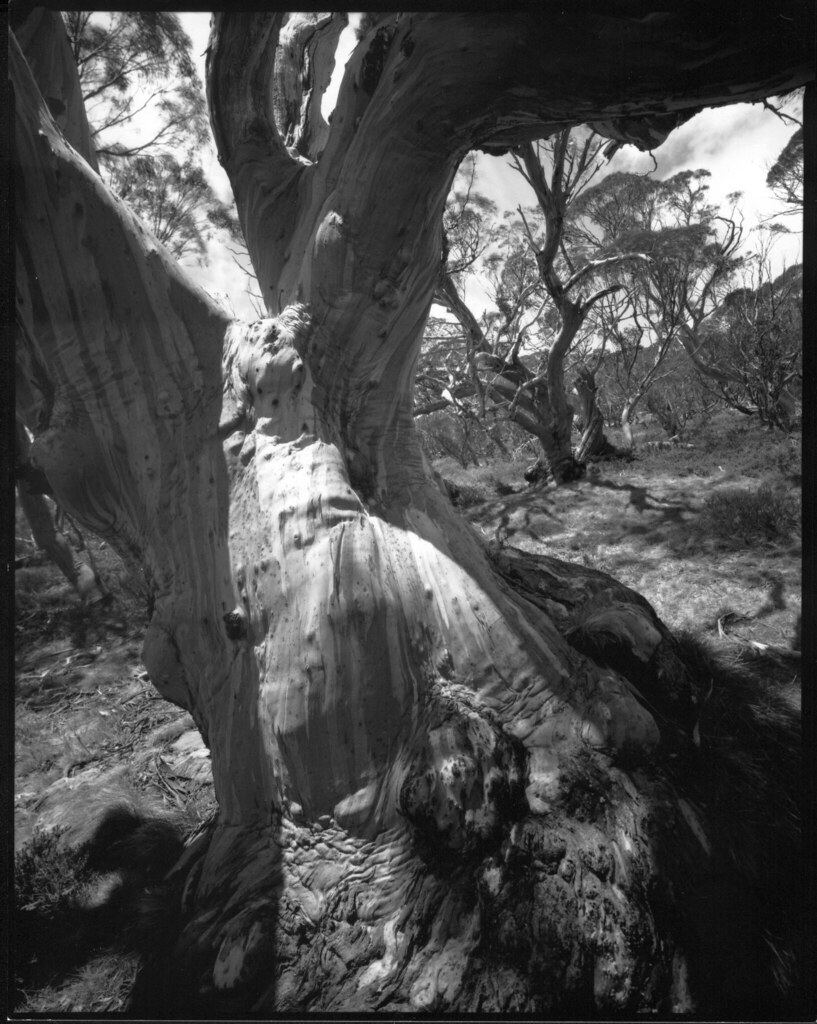
Here's an example:
Massive Snow Gum, Charlotte Pass
Gelatin-silver photograph on Fomabrom Variant III VC FB photographic paper, image size 24.5cm X 19.5cm, from a 8x10 Fomapan 200 negative
exposed at EI=100 in a Tachihara 810HD triple extension field view camera fitted with a Schneider Super Angulon 121mm f8.
The negative was tray developed at 31 Celcius for 3minutes 50 seconds and prints easily. This approach works in my old darkroom; for you, not gospel.




 cookingfilm.wordpress.com