• Welcome to Photrio!
    Registration is fast and free. Join today to unlock search, see fewer ads, and access all forum features.
    Click here to sign up

Troubleshooting Delta 100

Dump Truck Hat Trick

D
Dump Truck Hat Trick

  • 1
  • 0
  • 44
Street-Lamp

A
Street-Lamp

  • 3
  • 3
  • 87

Forum statistics

Threads
204,307
Messages
2,866,950
Members
102,220
Latest member
iDavidoff
Recent bookmarks
0

BLEX

Member
Joined
May 5, 2026
Messages
16
Location
Germany
Format
Analog
Hello everyone
Long-time lurker here, I was hoping for a little advice with a recent developing problem. I have been shooting b&w film for over 10 years, the vast majority FP4+, HP5 and Kentmere, in 35mm and 6x6.
I developed my first roll of Delta 100 yesterday. Film was purchased a couple of weeks ago in a bricks and mortar camera shop here in Munich, which is unusual for me, I mostly use a well-known online retailer. Expiry Feb 2029. Exposed in my OM-2n on aperture priority as usual, with the occasional adjustment here and there. Developed in Ilfotec HC 1+31 (the syrup is maybe 2 years old, but other rolls developed with the same syrup this week came out just fine, and HC is known for long shelf stability) for 6 mins as per the Ilford datasheet for ISO 100, agitation as per Ilford schemes. I did, as is my usual practice, a clip test on the fixer (Ilford Rapid Fixer, 1+4), and was happy with the clearing time of 60-90s, so fixed for a full 5 mins

I pull out the negatives and they look too dark. Fearing subpar fixing I put them back into fixer for a further 4 mins, and even mixed some fresh fixer just to be extra sure. This made no difference. Washed and hung to dry.

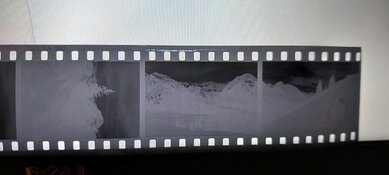
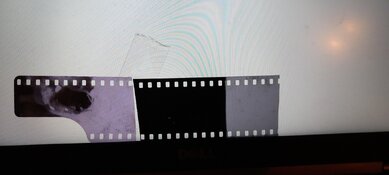
Pics are below. The first pic shows the film leader - the part on the left had fixer dripped on it (no developer) for about a minute. The part on the right is cut from the main film roll and so had developer as above and fixer. The images themselves look low in contrast and underexposed overall. the scratches near the sprocket holes are caused by handling after processing and can be ignored. The whole roll looks like this, though the extra base density is somewhat more apparent towards the end of the roll, in a rising uniform gradient. I know this camera tends slightly towards underexposure, but then not all images are underexposed, and the sprocket area looks too dense. Is this base fog? If yes, any ideas how this could happen on a freshly purchased roll of film that was well within expiry date? Thanks in advance!
 

Attachments

  • neg2.jpg
    neg2.jpg
    174.7 KB · Views: 111
  • neg.jpg
    neg.jpg
    51.4 KB · Views: 109
The first pic shows the film leader - the part on the left had fixer dripped on it (no developer) for about a minute.

So to get this straight, that part was not processed at all, apart from the drop of fixer? Or did you drop fixer onto it (again) after processing it?

The level of fog on your processed strip appears to be very high. I also have the impression (but it's hard to tell from a small pic) that the fog is significantly heavier along the sprocket holes and the edge of the film than in the center.

Was this roll of film taken on board of an airplane, and more importantly, through a CT scanner on the airport?
 
So to get this straight, that part was not processed at all, apart from the drop of fixer? Or did you drop fixer onto it (again) after processing it?

Correct, that part had fixer only, no dev.
I didn't take the film through an airplane / airport. Went pretty much straight from the shop to my freezer then to the camera. I wondered about heat damage, but then it hardly gets that hot in Germany.
 
It's not heat damage for sure.
Is this a bulk roll that you load into cassettes yourself, or ready-to-go cassettes confectioned by Harman/Ilford?
 
It's not heat damage for sure.
Is this a bulk roll that you load into cassettes yourself, or ready-to-go cassettes confectioned by Harman/Ilford?

It was a ready-to-go cassette.
 
Can you confirm that the fog is not even across the entire length of the film? I.e. that it's lighter in the center of the strip compared to the edges, and that it's heavier on one end than on the other?
 
Other than what Koraks is mentioning, it also looks like the light meter in your camera is causing underexposure due to the sky being in your shots. Dialing in a +1 exposure or shooting in manual mode with the extended sunny 16 rules would be a way to fix that. The Delta films and Pan F require more accuracy in exposure than Ilford's other offerings.
 
Can you confirm that the fog is not even across the entire length of the film? I.e. that it's lighter in the center of the strip compared to the edges, and that it's heavier on one end than on the other?

Its definitely lighter at the start of the roll - the attached pic with an image visible is from the end of roll and it looks more fogged to me than the leader. Whether its heavier in the center of the strip compared to the edges - I didn't think so from visual inspection.
 
Higher base density on one end of the roll suggests this is fogging of some kind. Fog of a chemical nature would have affected the entire roll to virtually the same degree. Fogging from light exposure inside the developing tank is exceedingly rare and if it happens, it's generally not perfectly even or with a nice gradient, but tends to feature strong streaks, blobs etc. So the odds are this fog is caused by stray light while handling the film, e.g. when spooling the film onto the processing reel. Under what conditions do you handle the exposed and unprocessed film? Do you use a changing bag, changing tent or a darkroom? Is this environment 100% dark?
 
Other than what Koraks is mentioning, it also looks like the light meter in your camera is causing underexposure due to the sky being in your shots. Dialing in a +1 exposure or shooting in manual mode with the extended sunny 16 rules would be a way to fix that. The Delta films and Pan F require more accuracy in exposure than Ilford's other offerings.
You're probably right - I did add a stop on many frames, in the more obviously backlit situations, but I've had similar issues with underexposure with Pan F with this camera in contrasty conditions, though not with other Ilford / Kentmere films
 
Thanks. I normally load the film into the tank in my bathroom - it has no windows. A tiny crack of light can pass between door and doorframe. I usually mitigate this by loading at night with all lights in the flat switched off. Now I think about it, I think some light on this occasion was on outside the bathroom, and I noticed a faint crack of light through the doorframe. I also always load with my back to the door, to shield the film from any stray light. I guess that if all other causes can be ruled out, this is all that remains.
Higher base density on one end of the roll suggests this is fogging of some kind. Fog of a chemical nature would have affected the entire roll to virtually the same degree. Fogging from light exposure inside the developing tank is exceedingly rare and if it happens, it's generally not perfectly even or with a nice gradient, but tends to feature strong streaks, blobs etc. So the odds are this fog is caused by stray light while handling the film, e.g. when spooling the film onto the processing reel. Under what conditions do you handle the exposed and unprocessed film? Do you use a changing bag, changing tent or a darkroom? Is this environment 100% dark?
 
This might indeed have been the cause; I'd give it another go, this time carefully blocking out any light and see if that improves matters.

Btw, I also agree with @loccdor on the underexposure. This would have been less of an issue if the fog wouldn't have been there, as this has swamped some of the shadow detail.
 
When printing we can get away to a degree with some stray light when missing a dedicated "real" darkroom, but panchromatic films have to be handled in complete and utter darkness. The very likely explanation is that you fogged your roll when loading it in the tank.

A changing bag such as the one sold by Paterson is a good investment
 
When printing we can get away to a degree with some stray light when missing a dedicated "real" darkroom, but panchromatic films have to be handled in complete and utter darkness. The very likely explanation is that you fogged your roll when loading it in the tank.

A changing bag such as the one sold by Paterson is a good investment

@BLEX I have never encountered this issue, but I always use a dark/changing bag to load film. If you choose to get one, just be warned that they build up humidity quite quickly which makes it a challenge to load the plastic reels. I switched to metal reels as a result.
 
Thanks. I normally load the film into the tank in my bathroom - it has no windows. A tiny crack of light can pass between door and doorframe.
If you go onto the bathroom, turn off the lights and wait 20 minutes for your eyes to adjust to the darkness - if you can see any light at all in the room it is not dark enough for loading or unloading film.

You need a changing bag. Get a large one.
 
A changing bag is definitely your friend here. Even a tiny crack of dim light can fog panchromatic film. The only time I have ever relied on the method of turning off all the lights and hoping for the best was the first time I developed ortho glass plates at 2ASA - in a red bucket. That just about worked.
 
I am going to differ from many of the posters here, because I consider changing bags to be instruments of the devil! :smile:
Admittedly, some struggle less with them than I do.
If you can block out light ingress into your bathroom, I'd recommend that instead.
 
Thanks all for all the advice! While somewhat surprised that this has happened for the first time now, I guess there's a first time for everything. I'll try taping up the door next time
 
I was able to get a large piece of black felt as a remnant at a fabric store, hanging that across the door makes a good light baffle.
 
Maybe it’s too obvious to mention but doing things at night goes a long ways towards fighting stray light. A dark house or at least hallway will cut 90% light from the start.
 
I principally have an issue with the gap between the vertical edge of the door and the door frame. Perhaps fashioning a curtain out of felt would be the way to go

Weather stripping for that :smile:
But an oversized blackout curtain outside the door may be the easiest.
Also from Amazon.de:
1778191473535.png


FWIW, our bathroom is at an end of a short (~ 1 meter) hall. I have curtains like that at the other end of that hall.
 
Photrio.com contains affiliate links to products. We may receive a commission for purchases made through these links.
To read our full affiliate disclosure statement please click Here.

PHOTRIO PARTNERS EQUALLY FUNDING OUR COMMUNITY:


Ilford ADOX Freestyle Photographic Stearman Press Weldon Color Lab Blue Moon Camera & Machine
Top Bottom