


• Welcome to Photrio!
    Registration is fast and free. Join today to unlock search, see fewer ads, and access all forum features.
    Click here to sign up

Toners

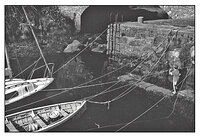
Boy and boats

A
Boy and boats

  • 1
  • 0
  • 8
sunset.jpg

A
sunset.jpg

  • 0
  • 0
  • 21

Recent Classifieds

Forum statistics

Threads
204,364
Messages
2,867,597
Members
102,234
Latest member
Sagasha
Recent bookmarks
2

sjg2000

Member
Joined
Feb 20, 2026
Messages
6
Location
Australia
Format
Analog
Hi all, I am new to toning silver gelatine prints and was wondering if anyone had any tips/tricks/recommendations for me. I'm using Ilford MG WT FB glossy paper. I have the Bergger gold toner which seems to make baby blue-cyan all the way through to blue-black. I've had a few instances where the toner makes a decently rich red, but not many-- and I don't know why it's doing this. It's never a whole print, usually just a blob or so. I saw someone say if you push a print in gold toner long enough you can get salmon pinks? no idea if thats true. I also saw someone say ilford selenium at strong dilutions (1+3 / 1+5) + gold toner can make an eggplant purple.

I essentially want to try and achieve as many colours as possible, regardless of how wacky. Are pinks possible? Greens? Reds? ETC?

Thank you everyone for your time in advance!
 
Virtually every color is possible, but it depends on the paper, how the print is developer, the toner and the extent of toning. Typically, warm-tone papers and prints developed for a very small grain size (e.g. overexposed print, but underdeveloped) tone more dramatically. An extreme case/instance of this is lith prints, which can tone rather violently.

I don't know what formulation the Bergger gold toner is; when I use gold toner, it's thiourea gold, which will produce a maroon/red hue on a very warm-toned wet print (e.g. Van Dyke contact prints) which dulls to a warm brown, but the color shifts to a cool-ish neutral if toning is extended. I've not heard of salmon pinks with regular prints in gold toner. Lith prints can go salmon even without a toner, but it depends very strongly on the paper used and the lith development.

You can get pinks and salmons with copper toner. Quite easily in fact. It's a relatively cheap toner to make, too.
Blues and cyans can be had with iron toning.
Green I've never really done, but you can do a combination of iron toning and sepia yellow toning, which will produce lime hues. There is likely a metal toner that will produce a greenish hue, but I've never looked into it specifically.
Sepia toning can do chocolate brown ranging to yellow. Vanadium apparently can produce yellows. Haven't tried it; I don't think it's a toner you ever see for sale commercially.

Apart from metal toners, there's also the possibility for dye toning; these products are less common, but perhaps they're still around. With dye toners, you can make all colors of the rainbow.

Toning is a vast domain with infinite possibilities. There's way too much about it to say for a single post, or even a single book. There's a very good book on toning by Tim Rudman, but I think it has gone out of print and 2nd hand it sells for big $$$.
 
Hi all, I am new to toning silver gelatine prints and was wondering if anyone had any tips/tricks/recommendations for me. I'm using Ilford MG WT FB glossy paper. I have the Bergger gold toner which seems to make baby blue-cyan all the way through to blue-black. I've had a few instances where the toner makes a decently rich red, but not many-- and I don't know why it's doing this. It's never a whole print, usually just a blob or so. I saw someone say if you push a print in gold toner long enough you can get salmon pinks? no idea if thats true. I also saw someone say ilford selenium at strong dilutions (1+3 / 1+5) + gold toner can make an eggplant purple.

I essentially want to try and achieve as many colours as possible, regardless of how wacky. Are pinks possible? Greens? Reds? ETC?

Thank you everyone for your time in advance!

You need to find a used copy of Tim Rudman's toning book.
 
Virtually every color is possible, but it depends on the paper, how the print is developer, the toner and the extent of toning. Typically, warm-tone papers and prints developed for a very small grain size (e.g. overexposed print, but underdeveloped) tone more dramatically. An extreme case/instance of this is lith prints, which can tone rather violently.

I don't know what formulation the Bergger gold toner is; when I use gold toner, it's thiourea gold, which will produce a maroon/red hue on a very warm-toned wet print (e.g. Van Dyke contact prints) which dulls to a warm brown, but the color shifts to a cool-ish neutral if toning is extended. I've not heard of salmon pinks with regular prints in gold toner. Lith prints can go salmon even without a toner, but it depends very strongly on the paper used and the lith development.

You can get pinks and salmons with copper toner. Quite easily in fact. It's a relatively cheap toner to make, too.
Blues and cyans can be had with iron toning.
Green I've never really done, but you can do a combination of iron toning and sepia yellow toning, which will produce lime hues. There is likely a metal toner that will produce a greenish hue, but I've never looked into it specifically.
Sepia toning can do chocolate brown ranging to yellow. Vanadium apparently can produce yellows. Haven't tried it; I don't think it's a toner you ever see for sale commercially.

Apart from metal toners, there's also the possibility for dye toning; these products are less common, but perhaps they're still around. With dye toners, you can make all colors of the rainbow.

Toning is a vast domain with infinite possibilities. There's way too much about it to say for a single post, or even a single book. There's a very good book on toning by Tim Rudman, but I think it has gone out of print and 2nd hand it sells for big $$$.

Thank you for this! Is there any reason why it would be problematic to combine the various metallic toners? Or can I just mix + match as I like to achieve the colours I want?

As for developer; I have ilford multigrade classic dev, but I was trying to see if I could 'print out' via extreme sun exposure. I know the ilford multigrade WT FB isn't POP paper, so not sure how successful it will be, but I have done really long sun exposures that have survived a full fix without change. I'm hoping that enough sun exposure would mean the silver would survive toner, and might add to colour variance (?). If this fails and I have to use dev, I have the multigrade classic - but I have seen that Ilford sells a warmtone dev too.
 
Last edited:
Virtually every color is possible, but it depends on the paper, how the print is developer, the toner and the extent of toning. Typically, warm-tone papers and prints developed for a very small grain size (e.g. overexposed print, but underdeveloped) tone more dramatically. An extreme case/instance of this is lith prints, which can tone rather violently.

I don't know what formulation the Bergger gold toner is; when I use gold toner, it's thiourea gold, which will produce a maroon/red hue on a very warm-toned wet print (e.g. Van Dyke contact prints) which dulls to a warm brown, but the color shifts to a cool-ish neutral if toning is extended. I've not heard of salmon pinks with regular prints in gold toner. Lith prints can go salmon even without a toner, but it depends very strongly on the paper used and the lith development.

You can get pinks and salmons with copper toner. Quite easily in fact. It's a relatively cheap toner to make, too.
Blues and cyans can be had with iron toning.
Green I've never really done, but you can do a combination of iron toning and sepia yellow toning, which will produce lime hues. There is likely a metal toner that will produce a greenish hue, but I've never looked into it specifically.
Sepia toning can do chocolate brown ranging to yellow. Vanadium apparently can produce yellows. Haven't tried it; I don't think it's a toner you ever see for sale commercially.

Apart from metal toners, there's also the possibility for dye toning; these products are less common, but perhaps they're still

You need to find a used copy of Tim Rudman's toning book.

Thank you Ralph, is it 'The Photographer's Toning Book: The Definitive Guide'? If so, it looks like an incredible resource and I thank you for bringing it to my attention! The only thing is it's quite pricy. I'm looking for a free PDF or a library availability, as I can't afford what's being charged online.

 
Is there any reason why it would be problematic to combine the various metallic toners? Or can I just mix + match as I like to achieve the colours I want?
There are limitations - quite a few, in fact. Some toners will 'override' or negate others, or alter the effect, or render the image less susceptible or even almost immune to further toning. So the order of application matters and there are no hard & fast rules.

Your print-out method should work in principle.
A warmtone developer can indeed make a difference with an eye to toning. You could also use a regular/neutral tone developer and intentionally underdevelop the print, but this can be tricky to control and there's a risk of uneven development/mottling. Alternatively, you could add a significant quantity of potassium bromide to a developer to 'warm it up' and make the image more receptive to toning.
 
In the mid 1980s I experimented with Colour dye coupler toners, my then girlfriends father photocopied a page about them in a 1960s BJP Annual. Essentially you use a re-halogenating bleach and then re-develop in a simple colour developer with the relevant dye coupler added, or mix of couplers.

I bought a 1949 BJP Almanac, a few years ago, and slipped inside was this leaflet for Johnson Colourform. There was an advert for it in the Almanac. Years later Tetenal made a similar kit which I know Bob Carlos Clarke used for some of his images in Dark Summer.

Johnson were the oldest of all photo-chemical manufacturers, they supplied Thomas Wedgwood, and later Fox Talbot. They manufacturer many raw photo chemicals, including colour developing agents and dye couplers.

This was my take on hand colouring & toning, an impromptu lecture I was asked to give when a visiting speaker was ill.

Ian
 
Last edited:
If you are serious about toning prints, you need to buy Tim Rudman's toning book.
There is 208 pages packed full of information and images explaining the complete toning process from start to finish.

I purchased this book a while back ago and it wasn't cheap. You could easily burn through a ton of paper and chemicals just trying to figure it out on your own. The learning curve could be long, steep and expensive. In my opinion, this book will save you money in the long run.
 
Tim Rudman's book is an example of something that you want, and which an internet option is a very poor substitute for.
The reason that you need the original is that the printing is excellent, and you can see the subtle colour variations that you need to see in order to understand things about toning.
That made it expensive to make, which is why there aren't many out there, and there are no publishers willing to reprint it.
And no you can't have mine :smile:.
 
Tim Rudman's book is an example of something that you want, and which an internet option is a very poor substitute for.
The reason that you need the original is that the printing is excellent, and you can see the subtle colour variations that you need to see in order to understand things about toning.
That made it expensive to make, which is why there aren't many out there, and there are no publishers willing to reprint it.
And no you can't have mine :smile:.

The problem Matt is papers have changed in 23 years, so toning effects will be different with current papers. A reprint would need to be a new edition with up-to-date examples Choice of paper, developer, and also development time, all have an impact on final image colour with toners.

The final fineness of grain in a print (emulsion) has an effect on the final tone/colour, this is often overlooked, with warm tone papers the finer the grain the warmer the image, longer development times increase the grain and produce cooler results. But it is the same with Bromide papers.

Personally I like the old Agfa approach for Sepia toners, copied by DuPont, from memory 3 different bleaches, and 4 toner, although I was using something similar before I bought my first Agfa Rezceptes book.

A secret of toning, is keep all your test strips and scarp prints for testing.

Ian
 
It's worth mentioning the late Bob Carlos Clarke, he became known initially for his Lith prints, toning, and hand colouring, first as a student at the RCA in London, a cover image of a BJP Annual, His first book "The Illustrated Delta of Venus", 1980, is a few of his images with a handful of stories from AnaĂŻs Nin's book Delta of Venus.

His second book "Obsessions", 1981, shows a marked progression in his approaches, but it is his third book "Dark Summer" that is the pinnacle of hit toning and hand colouring, he had stopped Lith printing, probably moved to LF. He was partnering with Agfa, featuring in their major advertising campaigns, using Tetenal's dye coupler chemistry. I saw the "Dark Summer" exhibition a couple of times, the image quality was amazing.

I met Bob Carlos Clarke in the late 1980s at a Trade show, also the second time I saw Dark Summer, although I'd already bought the book. We had a long conversation on techniques, particularly about using Dye couplers, he was using the Tetenal chemistry, I was mixing from raw chemistry.

Ian
 
I essentially want to try and achieve as many colours as possible, regardless of how wacky. Are pinks possible? Greens? Reds? ETC?

The most current product I have seen in this regard is Rockland's Polytoner. No idea, how to ship it down under, but if you can, then that's your thing.

If you are more playful, you could also use RA4 paper with your B&W negs and let the colors go crazy. With different filtration and dodging&burning you can achieve some really peculiar results. There is no choice of gradient, so be prepared to tune your negatives to the process, RA4 is higher contrast than B&W.

One further variation could be Fomapastel photopaper. In this case you get to pick between a number of crazy colors as back ground and put black silver on top of it. You can then tone the silver with the usual suspects, creating wild effects. A friend of mine once drove this to the peak by using an oil painting coated with liquid emulsion.

Ian already mentioned hand coloring, which can give you any color you want.

The problem Matt is papers have changed in 23 years, so toning effects will be different with current papers. A reprint would need to be a new edition with up-to-date examples Choice of paper, developer, and also development time, all have an impact on final image colour with toners.

Yes, one thousand times this. Modern paper is quite different and responds to toners very differently. The best part of Rudman's book remains, though: expertly made examples of what can be done with colors in a B&W print, a great source of inspiration.
 
If you are more playful, you could also use RA4 paper with your B&W negs and let the colors go crazy. With different filtration and dodging&burning you can achieve some really peculiar results. There is no choice of gradient, so be prepared to tune your negatives to the process, RA4 is higher contrast than B&W.

I just bought four hundred sheets of 11 x 14 Kodak Ektacolor SUPRA II paper for just such a project. I got it for $105 including shipping. It should be interesting to see what happens.
 
Thank you Ralph, is it 'The Photographer's Toning Book: The Definitive Guide'? If so, it looks like an incredible resource and I thank you for bringing it to my attention! The only thing is it's quite pricy. I'm looking for a free PDF or a library availability, as I can't afford what's being charged online.


as far as I remember, the book is actually online as a free pdf (without the permission of the author)and Tim Rudman sells a self-published reprint. I have neither, but was lucky enough to get a used copy at a high but still reasonable prize.
 
They haven't been made for quite a few years, maybe 20.

Ian

Thanks Ian I thought that was the case but maybe cliveh doesn't know this or presumably he wouldn't have posted about the Colorvir product that hasn't existed for many years

pentaxuser
 
I know the ilford multigrade WT FB isn't POP paper, so not sure how successful it will be, but I have done really long sun exposures that have survived a full fix without change. I'm hoping that enough sun exposure would mean the silver would survive toner, and might add to colour variance (?).

For Lumen prints and variants, direct toning with Polysulphide toner is a good option.
 
Thank you everybody for the fantastic suggestions and tips! Apologies for my delay, I have been caring for my elderly grandmother suffering from dementia: so I haven't had a chance to look at all your replies until now. I often trawl ebay for things, so I'll keep my eye out for Colovir and similar products.Thank you all again so much!
 
Photrio.com contains affiliate links to products. We may receive a commission for purchases made through these links.
To read our full affiliate disclosure statement please click Here.

PHOTRIO PARTNERS EQUALLY FUNDING OUR COMMUNITY:


Ilford ADOX Freestyle Photographic Stearman Press Weldon Color Lab Blue Moon Camera & Machine
Top Bottom
