

• Welcome to Photrio!
    Registration is fast and free. Join today to unlock search, see fewer ads, and access all forum features.
    Click here to sign up

The Copper Sulphide process

Untitled

A
Untitled

  • 1
  • 0
  • 27
The Hot Waters

A
The Hot Waters

  • 0
  • 0
  • 38

Forum statistics

Threads
204,318
Messages
2,867,104
Members
102,222
Latest member
forest_f2026
Recent bookmarks
0

Máx Arnold

Member
Joined
Jan 4, 2020
Messages
96
Location
Argentina
Format
Pinhole
Hello all, hope you're doing great!
I have become quite dormant on the forum, but I have slowly kept working. I recently rediscovered a Copper based process while I was working with Cuprous Chloride emulsions, I am going to share my lab notes and some examples in hopes you want to try it too.

This process is not formal (there's no standard procedure) yet. I do not fully understand it yet, but it's very promising. I will be attaching a formal procedure when I have investigated it more.

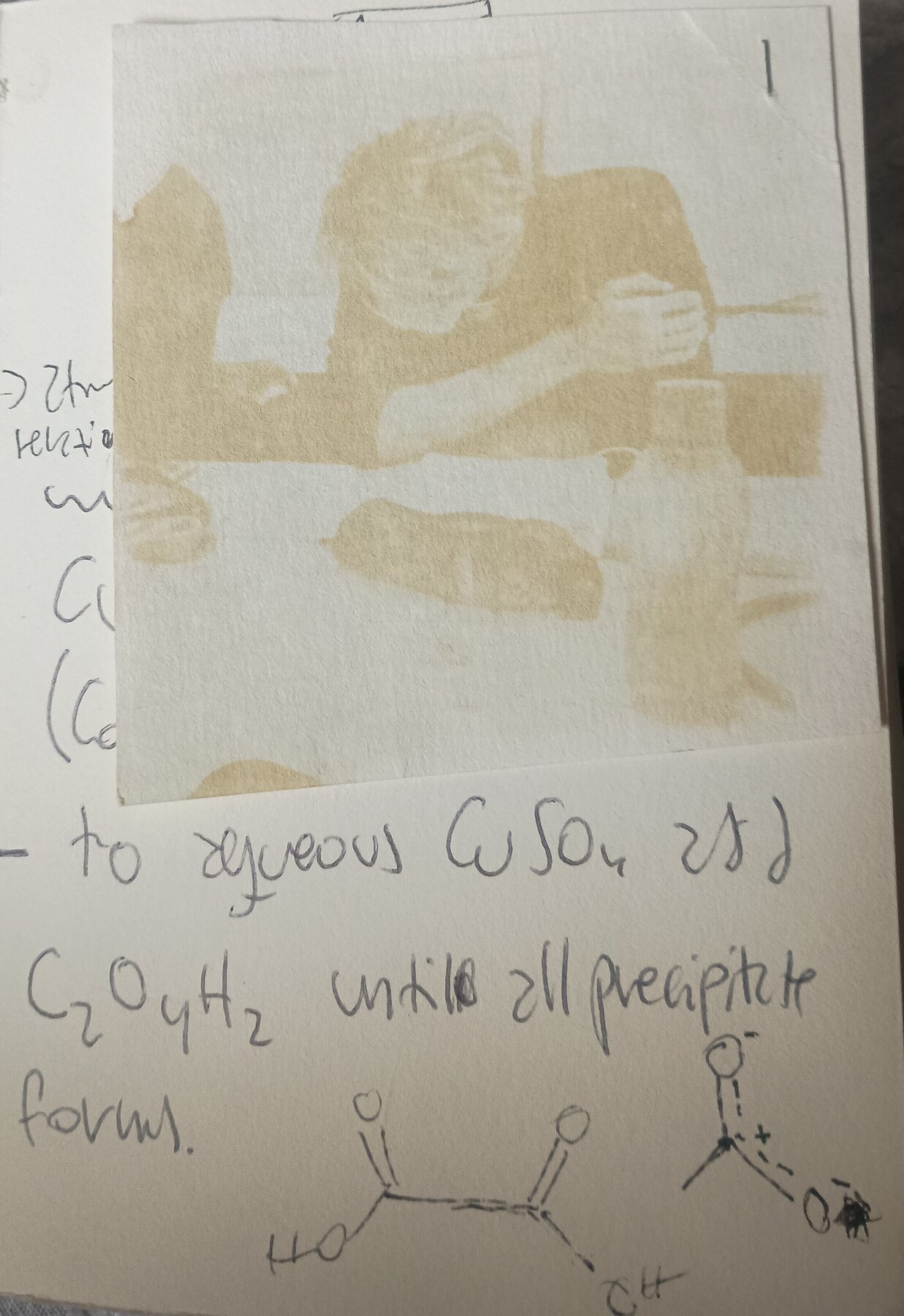
This is a Printing Out Process which makes use of a mixture of chelated Cu(I) and Liver of Sulphur (Potassium Sulphide and a mixture of polysulphides). The liquid sensitiser is not air sensitive, and under strong sunlight the image develops in sepia tones. It does not seem to benefit from fixing, apart from just needing a distilled water wash.

These are my lab notes from when I made the print I'll show you:

– to aqueous Copper Sulphate add Oxalic Acid until a light blue precipitate stops forming. Mix thoroughly and let set a little.
– create a buffer solution around pH 4.5 by mixing ascorbic acid and sodium bicarbonate.
–take the supernatant with the tiniest particles of precipitate from the first procedure, and mix with the Ascorbic acid buffer. The solution should clear into a lime green colour.
– add Liver of Sulphur with a couple drops of surfactant drop wise until the foam stops being blue and turns white.
This is the sensitiser and is instantly ready to use. Keep away from light.

Use a nice, absorbent and unbuffered watercolour paper. So called Cotton Sketch paper is good. Fabiano, Canson, all that should be good.
– Coat with a brush, and dry fully to prevent uneven exposure.
– Expose under a negative and glass plate for about 10 minutes in full sun. YMMV
Once it's exposed, the image should have appeared in a sepia tone.
– Wash with distilled water to remove any unreached salt.
– Dry.
IMG_20260419_144136233~2.jpg


This process seems to make use of the strong chelating effect AND photosensitivity of Oxalic Acid. The Copper (I) ion is fully sequestered in the complex, away from oxygen. When the acyl groups in the oxalate receive photons, they transfer their delocalised electron to the Copper, which instantly reduces and falls out of solution, then easily attacked by the sulphide to become fully stable and insoluble Copper (I) Sulphide.


Any comments are greatly appreciated :D
 
Hello all, hope you're doing great!
I have become quite dormant on the forum, but I have slowly kept working. I recently rediscovered a Copper based process while I was working with Cuprous Chloride emulsions, I am going to share my lab notes and some examples in hopes you want to try it too.

This process is not formal (there's no standard procedure) yet. I do not fully understand it yet, but it's very promising. I will be attaching a formal procedure when I have investigated it more.

This is a Printing Out Process which makes use of a mixture of chelated Cu(I) and Liver of Sulphur (Potassium Sulphide and a mixture of polysulphides). The liquid sensitiser is not air sensitive, and under strong sunlight the image develops in sepia tones. It does not seem to benefit from fixing, apart from just needing a distilled water wash.

These are my lab notes from when I made the print I'll show you:

– to aqueous Copper Sulphate add Oxalic Acid until a light blue precipitate stops forming. Mix thoroughly and let set a little.
– create a buffer solution around pH 4.5 by mixing ascorbic acid and sodium bicarbonate.
–take the supernatant with the tiniest particles of precipitate from the first procedure, and mix with the Ascorbic acid buffer. The solution should clear into a lime green colour.
– add Liver of Sulphur with a couple drops of surfactant drop wise until the foam stops being blue and turns white.
This is the sensitiser and is instantly ready to use. Keep away from light.

Use a nice, absorbent and unbuffered watercolour paper. So called Cotton Sketch paper is good. Fabiano, Canson, all that should be good.
– Coat with a brush, and dry fully to prevent uneven exposure.
– Expose under a negative and glass plate for about 10 minutes in full sun. YMMV
Once it's exposed, the image should have appeared in a sepia tone.
– Wash with distilled water to remove any unreached salt.
– Dry.
View attachment 422658

This process seems to make use of the strong chelating effect AND photosensitivity of Oxalic Acid. The Copper (I) ion is fully sequestered in the complex, away from oxygen. When the acyl groups in the oxalate receive photons, they transfer their delocalised electron to the Copper, which instantly reduces and falls out of solution, then easily attacked by the sulphide to become fully stable and insoluble Copper (I) Sulphide.


Any comments are greatly appreciated :D

You could try if you can "develop" to a darker tone with a mix of

3 gr K-Ferri
3 gr K-Ferro
some citric Acid (ph has to be below 5 or so)
in 300 ml of water.

This has given in many of my copper related processes a good reaction.
 
Hello all, hope you're doing great!
I have become quite dormant on the forum, but I have slowly kept working. I recently rediscovered a Copper based process while I was working with Cuprous Chloride emulsions, I am going to share my lab notes and some examples in hopes you want to try it too.

This process is not formal (there's no standard procedure) yet. I do not fully understand it yet, but it's very promising. I will be attaching a formal procedure when I have investigated it more.

This is a Printing Out Process which makes use of a mixture of chelated Cu(I) and Liver of Sulphur (Potassium Sulphide and a mixture of polysulphides). The liquid sensitiser is not air sensitive, and under strong sunlight the image develops in sepia tones. It does not seem to benefit from fixing, apart from just needing a distilled water wash.

These are my lab notes from when I made the print I'll show you:

– to aqueous Copper Sulphate add Oxalic Acid until a light blue precipitate stops forming. Mix thoroughly and let set a little.
– create a buffer solution around pH 4.5 by mixing ascorbic acid and sodium bicarbonate.
–take the supernatant with the tiniest particles of precipitate from the first procedure, and mix with the Ascorbic acid buffer. The solution should clear into a lime green colour.
– add Liver of Sulphur with a couple drops of surfactant drop wise until the foam stops being blue and turns white.
This is the sensitiser and is instantly ready to use. Keep away from light.

Use a nice, absorbent and unbuffered watercolour paper. So called Cotton Sketch paper is good. Fabiano, Canson, all that should be good.
– Coat with a brush, and dry fully to prevent uneven exposure.
– Expose under a negative and glass plate for about 10 minutes in full sun. YMMV
Once it's exposed, the image should have appeared in a sepia tone.
– Wash with distilled water to remove any unreached salt.
– Dry.


This process seems to make use of the strong chelating effect AND photosensitivity of Oxalic Acid. The Copper (I) ion is fully sequestered in the complex, away from oxygen. When the acyl groups in the oxalate receive photons, they transfer their delocalised electron to the Copper, which instantly reduces and falls out of solution, then easily attacked by the sulphide to become fully stable and insoluble Copper (I) Sulphide.


Any comments are greatly appreciated :D

Nice work and I would certainly like to give this process a try! I would think Sodium Sulphide can be used in place of Liver of Sulphur but is there a reason not to use the former?

Is there a way to intensify the image further? If the image-forming substance is indeed Copper Sulphide as you have mentioned, then toning (for e.g. in Ferricyanide) might not work. But if the image-forming substance also contains Copper compound besides the Sulphide, there is a good chance. Have you attempted brushing the image with Liver of Sulphur immediately after exposure or after the initial wash?

Some years ago I had great success with toning intermediate Cuprotype prints (i.e. after the Thiocyanate step in Jim Patterson's process) with alkaline Thiourea. Results were quite beautiful with the colour ranging from Sepia to black depending the alkalinity of the toning bath. Unfortunately, none of the prints survived the test of time and deteriorated within a year. Must note here that Jim Patterson's Selenosulphide toned Cuprotype prints have survived well. So I guess it all depends on specific Sulphides that form after toning. I do want to give Thiourea toning another try sometime in the future.
 
It just occured to me that Liver of Sulphur also contains some Thiosulphate along with Potassium Polysulphides. To be sure that it's the Polysulphides that are playing the primary role and not the Thiosulphate, you may want to check if your approach works if one were to use Thiosulphate in place of Liver of Sulphur.
 
Photrio.com contains affiliate links to products. We may receive a commission for purchases made through these links.
To read our full affiliate disclosure statement please click Here.

PHOTRIO PARTNERS EQUALLY FUNDING OUR COMMUNITY:


Ilford ADOX Freestyle Photographic Stearman Press Weldon Color Lab Blue Moon Camera & Machine
Top Bottom