• Welcome to Photrio!
    Registration is fast and free. Join today to unlock search, see fewer ads, and access all forum features.
    Click here to sign up

Make 4x6 prints with 6x7 negatives

Recent Classifieds

Forum statistics

Threads
203,179
Messages
2,851,008
Members
101,716
Latest member
Parartesan
Recent bookmarks
1

67II

Member
Allowing Ads
Joined
Mar 16, 2026
Messages
7
Location
Ohio
Format
Medium Format
Hi - new to this forum and just started my darkroom - so the learning begins. I have made postcards on 4x6 Ilford paper using 35mm negatives and a 50mm lens. I'd like to make the same size postcards (or very close) from my 120 film - 6x7 negatives. My lens for the 6x7 negatives is 105mm. My enlarger is a 23cII.
I fiddled around trying to make that work today but it may not be possible with a 105mm lens?

Appreciate your guidance/recommendations. My 1'st grader niece loves my analog postcards!

Thanks
 
Last edited:
Thanks - I'll check it out.
 
It should work, you just have to remember that a 4x6" print from 6x7 (negative is about 2.25 x 2.75") is only about 2x magnification. This means that for your 105mm lens, the negative-to-lens distance will be about 150mm, and the lens-to-paper distance will be about 300mm. This means the enlarger head may be higher, but the lens is racked further out, than you are used to from printing 4x6 from 35mm negatives.
 
Keep in mind that a 6x7 negative doesn't match a 4x6 print in the format ratio, as does a 3:2 35 mm negative. So you're going to have to crop to fill the paper or leave white borders on the paper if you wish to print the whole negative image.
 
I fiddled around trying to make that work today

Welcome to Photrio! What issue did you run into while trying to make it work? As said above by @reddesert, it's mostly a matter of whether the focus bellows will rack out far enough. I don't doubt it will since your use case isn't particularly extreme.
 
Acquiring an 80mm lens will resolve all the issues correct?
I appreciate the responses.
Thank you.
 
Keep in mind that a 6x7 negative doesn't match a 4x6 print in the format ratio, as does a 3:2 35 mm negative. So you're going to have to crop to fill the paper or leave white borders on the paper if you wish to print the whole negative image.
Thanks Alan - an 80mm lens will ease all the constraints correct?
 
Acquiring an 80mm lens will resolve all the issues correct?
It will make the distances smaller. The fundamental principle of having to rack out the bellows relatively far is inherent to making small enlargements.

Thanks Alan - an 80mm lens will ease all the constraints correct?
The aspect ratio of course remains the same.
 
Acquiring an 80mm lens will resolve all the issues correct?
I appreciate the responses.
Thank you.

Only some 80mm lenses have sufficient coverage to handle 6x7 lenses.
And for the ones that do, the corners of the negative might not be quite as well resolved as with a longer lens, such as the more usually recommended 90mm lens..
Of course, with small prints like 4"x6", you most likely won't be able to see any difference in those corners.
 
I'd simply stick with the 105 lens. You're not going to see any optical improvement with something shorter. The only hypothetical advantage would be a shorter column height position, which might in fact make dodging and burning more cramped. A purist might look for a 105 duplicating lens like a Rodagon D, designed for such a small magnification ratio; but no sense going down that rabbit hole if the regular 105 works OK. I've never used anything shorter than 105 for 6x7 work.
 
Thanks Alan - an 80mm lens will ease all the constraints correct?

Not really. You should experiment more with the combination of enlarger height and focus control. It is relatively common for people working near about 1:1 or 1:2 in enlarging or macro/copy work to find that they set up the target at some distance that makes it impossible to achieve focus. The cure is often (for copy work) to move the subject further away, and then iterate until you get the desired reproduction ratio. In the enlarging case, you may need to raise the head, get the print in focus, and then adjust the head lower and refocus in steps, until you get the print size where you want it.

I looked at the 23C manual linked by mshchem before posting, and it says you should be able to do a 1:2 enlargement with a 23C and a 105mm lens.
 
Thanks Alan - an 80mm lens will ease all the constraints correct?

No lens can change the differences in aspect ratios between the 6:7 negative and the 4:6 print.
 
No lens can change the differences in aspect ratios between the 6:7 negative and the 4:6 print.
Practically speaking, no.
Theoretically...sure. That's what anamorphic lenses do, after all. So it's not just a theoretical option, but it could be done in practice. However, it's questionable whether it's desirable as it'll stretch the image content horizontally. Round balls become eggs, people gain 50lbs, every car becomes a limo, apples become odd bananas, a slice of birthday cake becomes a loaf of cake and...hey...hold my beer - this is actually a great idea!
 
That's what paper trimmers are for. Start with 5x7 paper and trim down. Or just crop the image itself more linear to begin with. Never mind Koraks' suggestion ... that's how a number of people actually saw things back in hippie days with a little help from non-darkroom chemicals.
 
Last edited:
  • koraks
  • koraks
  • Deleted
  • Reason: nevermind, he evidently missed that opportunity.
In answer to the original question of Post #1:

You need an 80 mm lens. Good choices are either an 80 mm f/4 Rodagon or an 80 mm f/5.6 EL Nikkor. Both lenses are rated for full coverage of the 6 x 7 cm format by their makers, and both produce excellent results. (The 80 mm Componon-S lens is rated by Schneider for proper coverage only up to 6 x 6 cm format.)

There is a distinct advantage to using an appropriate 80 mm lens for 6 x 7 cm enlarging. It provides greater magnification for any given negative-to-image distance when compared to a longer focal length lens.

For example, with a 700 mm negative-to-image distance, a 105 mm lens provides 4.4X.

With an 80 mm lens, this is increased to 6.6X. This is important when you want to make large prints.

105 mm lenses are intended for the 6 x 9 cm format.
 
Last edited:
That's what paper trimmers are for. Start with 5x7 paper and trim down. Or just crop the image itself more linear to begin with. Never mind Koraks' suggestion ... that's how a number of people actually saw things back in hippie days with a little help from non-darkroom chemicals.
Practically speaking, no.
Theoretically...sure. That's what anamorphic lenses do, after all. So it's not just a theoretical option, but it could be done in practice. However, it's questionable whether it's desirable as it'll stretch the image content horizontally. Round balls become eggs, people gain 50lbs, every car becomes a limo, apples become odd bananas, a slice of birthday cake becomes a loaf of cake and...hey...hold my beer - this is actually a great idea!
Koraks never stopped. :wink:
 
Ian - gotta disagree with you - a slightly longer than "normal" lens uses more of the center of the optic, and is less likely to suffer from illumination falloff toward the corners, or less issues if the neg is a little off center in the carrier. Lots of advantages if there is sufficient column height. My 105 is an Apo Rodagon N, a really fine lens; but I sometimes use even longer lenses for 6x7, even a 150 Apo Rodagon N at times, which allows me to print wide open at full aperture if necessary, since only the center of the optical field is being used. (All my enlargers are tall floor standing models.)

When I bought my first 105 long ago, a Componon S, it was considered the standard focal length for 6x7. I sold it. A lot of this has to do with marketing. I'd consider anything 80mm a bare minimum length. Definitely avoid the 75mm El Nikkor for 6x7.
 
Last edited:
75/4 EL Nikkor Notes: Nikon rates its 75 mm f/4 N EL-Nikkor for a maximum of 6 x 6 cm coverage (48º coverage angle). Nikon doesn’t intend it for 6 x 7 and larger negatives.

That, and the 50 mm f/4 are both 4-element 3-group Tessar design—not the more sophisticated 6-element 4-group Double Gauss design of the rest of the EL-Nikkors and most other high-grade enlarging lenses regardless of the maker.

https://galerie-photo.com/manuels/el-nikkor-enlarging-lenses.pdf


Regarding Post #1: The original problem was to make a 4” x 6” borderless print from a 6 x 7 cm negative. The print size in millimeters is 101.6 mm x 152.4 mm.

I use the dimensions of the Mamiya RZ67 for the size of the image recorded on film: 56 mm x 69.5 mm.

The print size has aspect ratio 3:2. The largest 3:2 rectangle contained in the negative is 46.3 mm x 69.5 mm. This disregards the moderate edge cropping that occurs when using a glassless negative carrier.

The required magnification is m = 101.6 mm/46.3 mm = 2.19X (same as 152.4 mm/69.5 mm).

I use the 105 mm f/5.6 EL-Nikkor for this example since I have the data at hand. Its focal length is f = 105.5 mm.

The subject distance (negative to first nodal point) with a 105 mm lens is 152.9 mm at 2.19X.

The flange distance of the 105 mm f/5.6N EL-Nikkor is 100.5 mm. This places the first nodal point 5.0 mm forward of the flange.

I measured the distance from the negative to the bottom surface of a flat lens board on my Beseler 23CII when the focusing bellows were fully extended (lens stage against the bottom stop). It’s approximately 143 mm. That places the first nodal point about 148 mm from the negative.

Focusing is impossible with the 105 mm lens on a flat lens board at the indicated 2.19X magnification as the subject distance (negative to first nodal point) needs to be 152.9 mm.

Beseler makes a 5/8” (15.9 mm) extended lens board #8029 that would provide the necessary extension. Unfortunately, these are expensive if bought new.

https://www.bhphotovideo.com/c/product/4525-REG/Beseler_8029_39mm_Lensboard_with_5_8.html

They might be found more cheaply in used condition on, say, eBay. I think using one of the 80 mm lenses noted in Post #16 is a more practical solution. Or you could fabricate one using an existing flat lens board.

Regarding the comment at the bottom of post #12

“I looked at the 23C manual linked by mshchem before posting, and it says you should be able to do a 1:2 enlargement with a 23C and a 105mm lens.”

The 23C manual has the note below the focal length/magnification table:

“These magnifications are obtained by mounting these lenses in the extension cones available as accessories.”

The 23CIIXL manual specifies the use of the #8029 5/8-inch Extended lens board. The #8029 works properly on Beseler 23C, 23CII, and 23CIII models for 105 mm lenses.

http://www.jollinger.com/photo/cam-coll/manuals/enlargers/beseler/Beseler_23C_II.pdfsss

If you choose an 80 mm f/5.6N EL-Nikkor at 2.19X, the subject distance is reduced to 116.8 mm, well within the bellows range of the Beseler 23C enlarger.

I don’t believe that the image quality of the projection is compromised in any meaningful way when the print is only 4” x 6”.

 
Last edited:
I'm really impressed by the depth of discussion my post created - thank you for all the intellectual capital!
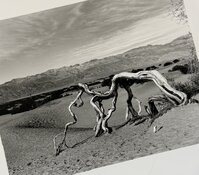
Instead of sticking to my 4x6 postcard requirement I looked up the USPS limits on postcard size. Max is 6x9. Knowing that, I decided for my 6x7 film I would just measure the exact negative dimension and use 2x or 3x that size to create a postcard on portfolio stock. Made one yesterday and it came out approx 5.5x7. Image attached from Death Valley.
For now I'll stick to my 35mm film and my 50mm lens for 4x6" card stock. I can sometimes go down a rabbit hole around equipment that ends up being used less than I anticipated. Ever happen to you?
Thanks again.

Now as a new darkroom printer I'm facing the dilemma of creating a standard workflow (or nearly so). I've been learning the split grade approach. Be great to hear what you have decided relative to your typical workflow?
I use Ilford MG pearl RC paper and their developer 1:9. Going to try a run on Bromophen too.

Some recent negatives have been a bit dense and over developed but I have corrected that. I'm trying to stick (for now) with FP4 and XT3 developer - with the philosophy of "learn one well" before experimenting.
Thanks. IMG_3893 copy.jpeg
 
When I do batches of postcards, I do bordered ones.
I trim 8x10 paper to 7x10, and make two 5x7 bordered prints back to back on the same sheet. I do that by printing one, removing the paper from the easel and rotating it 180 degrees and printing the second on the other half of the sheet.
I print them in batches of 4 - 6 sheets at a time, then develop them together in a large tray, using a longer developing time and shuffling continually.
After everything is processed and, where applicable, toned, and everything is dry, I cut the sheets into two.
When you do your tests you need to incorporate the longer developing time and a bit of waiting time between exposure and development.
And for what it's worth, I usually pick negatives that are relatively straightforward to print! :smile:
 
And for the ones that do, the corners of the negative might not be quite as well resolved as with a longer lens, such as the more usually recommended 90mm lens..
Of course, with small prints like 4"x6", you most likely won't be able to see any difference in those corners.
Ian - gotta disagree with you - a slightly longer than "normal" lens uses more of the center of the optic, and is less likely to suffer from illumination falloff toward the corners, or less issues if the neg is a little off center in the carrier. Lots of advantages if there is sufficient column height. My 105 is an Apo Rodagon N, a really fine lens; but I sometimes use even longer lenses for 6x7, even a 150 Apo Rodagon N at times, which allows me to print wide open at full aperture if necessary, since only the center of the optical field is being used. (All my enlargers are tall floor standing models.)

When I bought my first 105 long ago, a Componon S, it was considered the standard focal length for 6x7. I sold it. A lot of this has to do with marketing. I'd consider anything 80mm a bare minimum length. Definitely avoid the 75mm El Nikkor for 6x7.
These are good points. FWIW I've been printing forever with the 80mm's (Rodagon and Componon f4) from 6x9 (!) around 17x24cm print size without issues, in an enlarger designed for 4x5+. And I only recently thought about it. There is a 95mm and 105mm somewhere in our community Darkroom and I should begin to use it more often.
I did notice some illumination irregularities in some frames, which might come from that. I even enlarged to 50cm wide prints using the whole width of the negative, but now that I think of it, these might have a slight softness.

Ilford used to have Postcard Paper. But nowadays I guess ordinary paper works well; just draw the postcard outlines in the back.
 
Ilford used to have Postcard Paper. But nowadays I guess ordinary paper works well; just draw the postcard outlines in the back.

Harman still make 4"x6" Ilford paper on the extra heavy Portfolio RC stock though - it just doesn't have the printing on the back.
 
75/4 EL Nikkor Notes: Nikon rates its 75 mm f/4 N EL-Nikkor for a maximum of 6 x 6 cm coverage (48º coverage angle). Nikon doesn’t intend it for 6 x 7 and larger negatives.

That, and the 50 mm f/4 are both 4-element 3-group Tessar design—not the more sophisticated 6-element 4-group Double Gauss design of the rest of the EL-Nikkors and most other high-grade enlarging lenses regardless of the maker.

https://galerie-photo.com/manuels/el-nikkor-enlarging-lenses.pdf


Regarding Post #1: The original problem was to make a 4” x 6” borderless print from a 6 x 7 cm negative. The print size in millimeters is 101.6 mm x 152.4 mm.

I use the dimensions of the Mamiya RZ67 for the size of the image recorded on film: 56 mm x 69.5 mm.

The print size has aspect ratio 3:2. The largest 3:2 rectangle contained in the negative is 46.3 mm x 69.5 mm. This disregards the moderate edge cropping that occurs when using a glassless negative carrier.

The required magnification is m = 101.6 mm/46.3 mm = 2.19X (same as 152.4 mm/69.5 mm).

I use the 105 mm f/5.6 EL-Nikkor for this example since I have the data at hand. Its focal length is f = 105.5 mm.

The subject distance (negative to first nodal point) with a 105 mm lens is 152.9 mm at 2.19X.

The flange distance of the 105 mm f/5.6N EL-Nikkor is 100.5 mm. This places the first nodal point 5.0 mm forward of the flange.

I measured the distance from the negative to the bottom surface of a flat lens board on my Beseler 23CII when the focusing bellows were fully extended (lens stage against the bottom stop). It’s approximately 143 mm. That places the first nodal point about 148 mm from the negative.

Focusing is impossible with the 105 mm lens on a flat lens board at the indicated 2.19X magnification as the subject distance (negative to first nodal point) needs to be 152.9 mm.

Beseler makes a 5/8” (15.9 mm) extended lens board #8029 that would provide the necessary extension. Unfortunately, these are expensive if bought new.

https://www.bhphotovideo.com/c/product/4525-REG/Beseler_8029_39mm_Lensboard_with_5_8.html

They might be found more cheaply in used condition on, say, eBay. I think using one of the 80 mm lenses noted in Post #16 is a more practical solution. Or you could fabricate one using an existing flat lens board.

Regarding the comment at the bottom of post #12

“I looked at the 23C manual linked by mshchem before posting, and it says you should be able to do a 1:2 enlargement with a 23C and a 105mm lens.”

The 23C manual has the note below the focal length/magnification table:

“These magnifications are obtained by mounting these lenses in the extension cones available as accessories.”

The 23CIIXL manual specifies the use of the #8029 5/8-inch Extended lens board. The #8029 works properly on Beseler 23C, 23CII, and 23CIII models for 105 mm lenses.

http://www.jollinger.com/photo/cam-coll/manuals/enlargers/beseler/Beseler_23C_II.pdfsss

If you choose an 80 mm f/5.6N EL-Nikkor at 2.19X, the subject distance is reduced to 116.8 mm, well within the bellows range of the Beseler 23C enlarger.

I don’t believe that the image quality of the projection is compromised in any meaningful way when the print is only 4” x 6”.

Terrific analysis!!

I've used a Beseler 4x5 enlarger (not the same one) since I was a kid. I've never required an extended lens board. I use the 3 lens turrets, some lenses require very short extension tubes to enable the rear element to clear the turret shell for rotation. Oh the joys of analog, it's what makes it so rewarding!
 
Photrio.com contains affiliate links to products. We may receive a commission for purchases made through these links.
To read our full affiliate disclosure statement please click Here.

PHOTRIO PARTNERS EQUALLY FUNDING OUR COMMUNITY:


Ilford ADOX Freestyle Photographic Stearman Press Weldon Color Lab Blue Moon Camera & Machine
Top Bottom