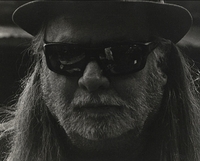
one thing I've noticed with AI images is it LOVES razor thin depth of field
"It" doesn't like anything. This is just a generation mode that's used a lot. These models aren't limited to shallow DoF images. There's plenty of "f/64" work being made as well. What we're mostly seeing right now is stylistic poverty. If you give a thousand random people oil paints, what do you reckon you'll get? That's right - a sticky mess. Not a whole lot that's worth looking at. With AI, the issue is that since it's a gadget (essentially), the people who warm up to it presently at a large scale are people who like gadgets. And while
some people with a fondness for gadgets have artistic talent, the vast majority are just like any other people - of moderate talent, at best. So what they generate is repetitive and unimaginative. I've said it before - I've been following AI 'art' in one place for a while and the picture styles boil down to (1) anime, (2) star wars-kind of sci fi scenes, (3) imagery of violent women. It's no surprise, because these people are essentially geeks (I don't mean that in a derogatory way, but to describe their general interest in technology as well as certain genres of media) and they end up creating what they consume. In that sense, these people aren't too different from AI, and they suffer from the same limitation: much like AI, most people find it very hard to imagine anything that deviates strongly from what they already know.
As it stands with art of all kinds it's a passing fad. It's an assist tool that is shiny and new now and used to crank out slop. Sooner or later the next thing will come along.
Nah, I don't think so, really. I mean, perhaps we will at some point raise the bar a little for calling something 'art'. That would be nice. But I'm convinced that insightful, creative, socially-engaged art will be created sooner or later with AI. Think about it; it's just like photography. Sooner or later someone comes along and does something with the new medium that blows everybody's mind. Then of course most people get angry and reject it, because it's not what they're used to. But bit by bit, the new 'fad' gains following and evolves, and ultimately gains a wider acceptance. How long did it take for photography to be accepted as an art form at a similar level as painting etc.? Arguably, it's not even there yet, and it's been 150+ years in the making. AI-generated imagery has been around in substantial quantities for 5 years or so, if that, even. Doesn't make a whole lot of sense to declare it dead; we're not even scratching the surface on this thing. Remember (if you're old enough) how some businesses in the mid-1990s said that the whole online thing would blow over and why would they invest in a website; it would wear off. Then they were all proved "right" with the dotcom bubble in 2000. Yeah, we all know how that went down, ultimately.
I sure miss the "a picture is worth a thousand words" days
That's an interesting remark as there's a lot going on if you start to untangle it, I think.
First thing that comes to mind is that it takes only a limited number of words to generate most of the Ai imagery we're seeing currently; let's say a couple of dozen at the most. That's a far cry from "a thousand", but this direct relationship between words (as input) and an image (as output) does provide us with an additional insight into the relation between text and imagery in terms of information richness. Now, if you were to generate an AI image with a prompt of let's say 20 words, it will likely take a whole lot more words to describe the end result. Approaching this very simplistically, you can ask where the additional information content came from. The evident answer is that AI "made it up", or "borrowed" it from other sources (or, more accurately: something in-between those concepts). That 'borrowing/make-up' is not necessarily directed; it'll be in line with the actual prompt that was given and correlate (in terms of existing/known data) with this prompt. And that makes it inherently "unimaginative". Then again, if you look at lots of (bona fide) art, there's also stylistic congruence within bodies of work that could (if you're critical) be regarded as some form of replication.
Extending this line of thought - what happens if we dramatically increase the number of words a prompt is constructed from? Present-day LLM's are relatively crude and limited due to the nature of the computations involved and the way we're presently implementing them. It's a very, very big crow bar to open a very small box. One of the inevitable lines of progress will be that we'll build (1) even bigger crowbars at lower cost and (2) we will undoubtedly at some point figure out other tools besides crowbars to do the same job. Either way, these generative models will become capable of handing vastly larger inputs, and at that point it will become possible to turn, say, a short story or a novel into an image. What happens if you work 10k words into a single image - will it actually become 'worth' 10k words? Probably not always, but there's a decent possibility we're going to see imagery arise of a complexity and nuancedness that is difficult for us humans to comprehend, let alone make.
The main problem here remains that thinking about AI, many of us remain stuck in two modes that also interact:
(1) our imagination is limited and we're trying to linearly predict the progress of something that will develop non-linearly. I.e. how society will evolve under influence of AI (and vice versa) is simply too complex to predict, and as a result, how it'll unfold will be by definition unimaginable - it will catch all of us by surprised, and:
(2) change is pretty damn scary for most people (I'd say
all, eventually) so our natural response to change that's also uncontrollable is rejection.
Especially #2 troubles the waters (hehe, see what I did there...), sometimes to a point that someone gets so riled up by just
thinking about all this is enough to make them storm out in a flurry while banging the door behind them (see one page above). It's a panic response, which I think is illustrative for the fear instilled by radical change - and I think that's a very human response (although not necessarily a very productive one).
Also, #1 I always find rather ironic, because one of the problems people often have with AI is that it's unimaginative. But then when I look at the vast majority of work, solutions, inventions etc. that the vast number of humans come up with - guess what, they're also not super imaginative. So what? We've evolved to come up with solutions that work well enough to survive to the next generation. It's only natural that we do, like, 99.9% tried-and-tested stuff and only 0.1% new. We were not trained to be creative; we were trained to replicate. Now, we've made a tool that basically does the same thing adn then people all throw a hissy-fit that it's 'unimaginative'. Honestly, that never fails to make me chuckle.