
• Welcome to Photrio!
    Registration is fast and free. Join today to unlock search, see fewer ads, and access all forum features.
    Click here to sign up

Changing focal length with a diopter?

Frozen Pool

Frozen Pool

  • 2
  • 4
  • 34
Greenhouse Volunteer

H
Greenhouse Volunteer

  • 3
  • 0
  • 52

Recent Classifieds

Forum statistics

Threads
202,396
Messages
2,840,116
Members
101,311
Latest member
Schnurbamm
Recent bookmarks
0

Donald Qualls

Subscriber
Allowing Ads
Joined
Jan 19, 2005
Messages
12,545
Location
North Carolina
Format
Multi Format
This just popped into my head the other day -- at present the only "modern" lens I own for 4x5 is a Compon 150 f/5.6 (which I've also used as a 265 f/13 with only the rear group -- with good results at least when stopped down). It occurred to me, though, that adding a diopter would shorten for focal length -- and since this lens has plenty of image circle, moving it closer to the film plane to focus infinity with a +1, +2, even +4 diopter (about all I've got the bellows compression for) might be practical.

I know the diopters I can afford are likely to degrade image quality by a small amount, but has anyone actually tried this? Does image circle run out faster than I think it will? Or would I be a lot ahead on image quality to use the 135 f/4.5 Tessar and 105 f/4.5 triplet (branded by the camera maker, covers at f/22 and focused to 12 feet or closer) that I already have?

Wait, I just remembered I have a 90 mm f/6.8 (IIRC) Angulon...
 

Maris

Member
Allowing Ads
Joined
Jan 17, 2006
Messages
1,594
Location
Noosa, Australia
Format
Multi Format
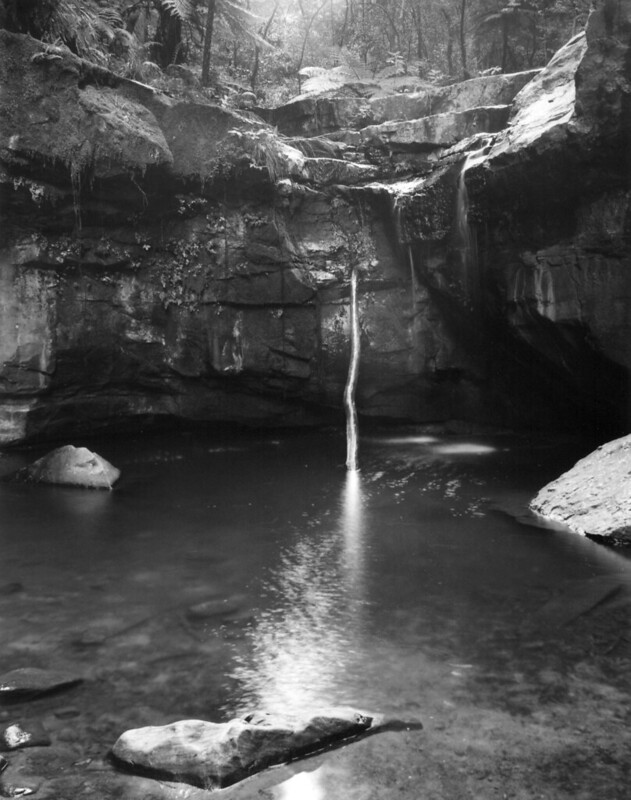
50095478998_2a2c18fd8e_c.jpg

Carnarvon Gorge, Moss Garden
Gelatin-silver photograph on Agfa Classic photographic paper, image size 24.7cm X 19.3cm, from a 8x10 Tmax 400 negative exposed in a Tachihara 810HD field view camera
fitted with a Fujinon-W 300mm f5.6 lens and a #1 close-up lens for a wider field of view.

There was only one place to stand for this one and I needed a space above the waterfall and the big foreground rock for a balanced composition.
The close-up lens left me with just enough image circle and f64 sharpened up the corners. Job done.
 

wiltw

Subscriber
Allowing Ads
Joined
Oct 4, 2008
Messages
6,751
Location
SF Bay area
Format
Multi Format
The issue is that the Dioter does not 'change FL'; it has a focal length of its own...


f(meters) = 1 / Diopter (D),

...this is the focal length equivalence of the closeup lens. If you hold the Diopter out in front of you, notice that it INVERTS the image. But if you put a converter lens (which alters the FL of the primary optic) out in front of you, it presents an image which its NOT INVERTED.
I just took out a Canon WA convertor and a Canon teleconvertor both meant to be screwed in front of a Canon Powershot G2 point and shoot, and BOTH present non-invertered images (of different sizes) of the scene thru the convertor.
 

OAPOli

Member
Allowing Ads
Joined
Sep 26, 2022
Messages
872
Location
Toronto
Format
Medium Format
Congratulations, you have invented the close-up filter :smile:

The focal length of the diopter can be computed as shown above. The combined focal length F will be 1/F = 1/f + 1/fD where f and fD are your lens and diopter focal length, respectively.
 

_T_

Member
Joined
Feb 21, 2017
Messages
451
Location
EP
Format
4x5 Format
I use diopters for lf quite a bit.

There are a few drawbacks. The image circle will usually be slightly smaller than ideally predicted, the ffd will usually be slightly shorter than ideally predicted.

With some lenses it will introduce a pretty strong curve to the plane of focus. Sometimes it will be worse with a single lens diopter design but sometimes an achromatic doublet diopter will cause worse field flatness, it depends on the design of the lf lens.

You might also see some chromatic aberration towards the corners of the image.
 

loccdor

Subscriber
Joined
Jan 12, 2024
Messages
2,998
Location
USA
Format
Multi Format
Some diopters are meniscus lenses, some are plano convex, and some use multiple elements.
 

grahamp

Subscriber
Allowing Ads
Joined
Mar 2, 2004
Messages
1,775
Location
Vallejo (SF Bay Area)
Format
Multi Format
A 150mm prime with a +3 diopter close-up lens will get you a 103mm effective focal length. Assuming there is no vignetting, the angle of view will be unchanged in practice, and will be proportional to the focal length change. It will be around IC = 103/150. A bare positive diopter is likely to add aberrations, though
a yellow or green filter can help with chromatic aberration. What you actually get may be better or worse.

A lot depends on the format, the lens(es), and how much you can stop down. I do it sometimes to get my 135mm down to 106mm (-ish) using a +2 for use on a 2x3 camera. Easy enough to try.
 

xkaes

Subscriber
Allowing Ads
Joined
Mar 25, 2006
Messages
5,230
Location
Colorado
Format
Multi Format
How to quickly add to your lens arsenal -- use close-up LENSES: Here are the formulas, and the formula to figure out how much IC you lose. The quality depends on the quality of the close-up LENSES:

www.subclub.org/fujinon/close-up.htm
 
OP
OP
Donald Qualls

Donald Qualls

Subscriber
Allowing Ads
Joined
Jan 19, 2005
Messages
12,545
Location
North Carolina
Format
Multi Format
the Dioter does not 'change FL'; it has a focal length of its own..

And when you add the diopter strength of the close-up lens to that of the camera lens, you get a shorter focal length for the combination.

the angle of view will be unchanged in practice,

Am I reading this correctly, that a 150 mm lens and +3 diopter will have the same angle of view as the 150 mm lens by itself, and not an angle comparable to the 105 mm triplet I've used on my Speed Graphic?
 

titrisol

Subscriber
Allowing Ads
Joined
Aug 2, 2004
Messages
2,101
Location
UIO/ RDU / RTM/ POZ / GRU
Format
Multi Format
Congratulations, you have invented the close-up filter :smile:

The focal length of the diopter can be computed as shown above. The combined focal length F will be 1/F = 1/f + 1/fD where f and fD are your lens and diopter focal length, respectively.
There were also the Zeiss Distars, (diverging) which made the lenses "longer,"
Distar 3 made the 50mm lens act like a 70mm
Proxars were close up and IDK if there was one that made it wider

Screen-Shot-2020-08-11-at-7.38.57-AM.png


and the Zeiss brochure here
 

Dan Fromm

Member
Joined
Mar 23, 2005
Messages
6,945
Format
Multi Format
Donald, on which camera do you want to use your 150 Componon + diopter?

If it is press or view camera that focuses on a ground glass by adjusting the front standard-to-film plane distance, just set it up and play around.

Most of the comments you got seem to reflect experience with cameras that have fixed flange-to-film distances. With them, putting a + diopter on a lens reduces the lens' focal length and far focusing distance.
 
OP
OP
Donald Qualls

Donald Qualls

Subscriber
Allowing Ads
Joined
Jan 19, 2005
Messages
12,545
Location
North Carolina
Format
Multi Format
Distar 3 made the 50mm lens act like a 70mm
Proxars were close up and IDK if there was one that made it wide

I think those were afocal lenses like the ones still made and sold for cell phone cameras and such.

Donald, on which camera do you want to use your 150 Componon + diopter?

It'd be either my Anniversary Speed or my Graphic View II, at least a present. I might manage to acquire a 4x5 field camera sometime, where it would make more difference to limit the number lenses and lens boards I need to haul...
 

wiltw

Subscriber
Allowing Ads
Joined
Oct 4, 2008
Messages
6,751
Location
SF Bay area
Format
Multi Format
Am I reading this correctly, that a 150 mm lens and +3 diopter will have the same angle of view as the 150 mm lens by itself, and not an angle comparable to the 105 mm triplet I've used on my Speed Graphic?

As Sigma describes it..."Diopters are, simply put, a magnifying glass for a camera lens. They make an object bigger and decrease the minimal focus distance so you can get macro shots without having to use a lens specifically for macro shots."
 

xkaes

Subscriber
Allowing Ads
Joined
Mar 25, 2006
Messages
5,230
Location
Colorado
Format
Multi Format
A #3 CU lens added to the front of a 150mm lens produces approximately a 103mm lens. If you have a camera with an adjustable bellows you can focus to infinity since the focal length of the prime lens is shortened. The details are listed in the URL above.

Adding the CU lens will minimize the image circle. Using Gullstrand's formula, if your 150mm lens has an IC of 200mm, the IC will be reduced to about 137mm with the addition of a #3 CU lens, but, you get the view of a 103mm lens. So, depending on the film format, the image might not cover the film, but you can always deal with that under the enlarger. And, of course, you might have to deal with vignetting with a much wider lens.

You can also use CU lenses under an enlarging lens if you want to make a larger print -- and have run out of height on the enlarger. Since you normally stop down an enlarging lens, quality loss will be minimal.

Want a BIGGER image from a slide projector? Stick a CU lens onto the front of the projector lens. Since you can't stop down the lens, the edges might appear softer.
 
OP
OP
Donald Qualls

Donald Qualls

Subscriber
Allowing Ads
Joined
Jan 19, 2005
Messages
12,545
Location
North Carolina
Format
Multi Format
As Sigma describes it..."Diopters are, simply put, a magnifying glass for a camera lens. They make an object bigger and decrease the minimal focus distance so you can get macro shots without having to use a lens specifically for macro shots."

This is applicable to cameras that don't allow moving the lens closer to the film, but for large format, within limits, you can do that. Both my Speed Graphic and my Graphic View II will focus infinity with a 105 mm lens, and at least the Speed ought to with a 90 mm, so it ought to be reasonable to get infinity focus with a 103 mm equivalent 150 and +3. Put a +3 on one of my RB67 lenses and my longest focus distance will be around 33 cm, or about 14 inches...
 

Alan Townsend

Member
Joined
Dec 7, 2025
Messages
201
Location
Peoria, IL, USA
Format
Multi Format
Diopters fo focal lengths.

+1 - 1 meter about 40 inches
+2 - .5 meter about 20 inches, good for 16x20 camera with curved film holder, concave face forward with aperture plan in front of lens.

+4 - .25 meter about 10 inches, good for 8x10 camera as above

Yes, adding these will shorten the focal length of a lens.

I want a negative diopter lens to turn my 28mm-200 zoom to a 90mm-700 zoom that covers 4x6, yes it would need to be behind the lens.

I am joking. This is possible in theory, but would be horrible images.
😀
 

villagephotog

Subscriber
Allowing Ads
Joined
Jun 1, 2019
Messages
108
Location
USA
Format
Medium Format
How to quickly add to your lens arsenal -- use close-up LENSES: Here are the formulas, and the formula to figure out how much IC you lose. The quality depends on the quality of the close-up LENSES:

www.subclub.org/fujinon/close-up.htm

FWIW, I had read the article that xkaes referenced above and was interested in using this technique with my 4x5 camera and lenses.

I already owned a couple of Konica achromatic doublet C/U lenses that perform extremely well on my Nikon lenses for 35mm and APS-C formats; they are very good optically.

I tested the Konica C/U #1 on both my WA Congo 120mm f/6.3 and my Fujinon L 210mm f/5.6 9 (at F/22 on both). The results were not particularly great. On the Congo, especially, there was a noticeable degrading of sharpness away from the image center. The Fujinon was better, but still getting noticeably soft towards the frame edges.

In the end, I didn't see much real advantage; it makes my widest lens somewhat wider, but at a pretty big penalty in image quality. On my longer lens, it works better, but the result is not meaningfully better than just shooting with my wide angle and cropping to a narrower angle of view.
 

_T_

Member
Joined
Feb 21, 2017
Messages
451
Location
EP
Format
4x5 Format
The results one gets with a close up lens are dependent on the design of both the close up lens and the design of the large format lens you put it on.

With some designs an achromat close up lens will produce a better image while with others a simple meniscus or planoconvex lens will perform better, while some lenses simply won’t perform well with any close up lens.

You’re basically altering the design of the lens by installing the filter and lens design in a pretty complex task, so the results you get by blindly sticking an element or two in front of a previously properly corrected system can vary greatly.
 

xkaes

Subscriber
Allowing Ads
Joined
Mar 25, 2006
Messages
5,230
Location
Colorado
Format
Multi Format
I am joking. This is possible in theory, but would be horrible images.

It's not just a theory. There are plenty of front-end tele-converters that increase the effective focal length of lenses. They are simply better-corrected, and more expensive, than simple negative meniscus lenses. I have a Schneider 1.4X and Minolta 1.5X converters that work great -- especially when stopped down. My Konica/Minolta has a fixed 28-200mm zoom, but with the converters, it reaches 300mm.
 

xkaes

Subscriber
Allowing Ads
Joined
Mar 25, 2006
Messages
5,230
Location
Colorado
Format
Multi Format
You’re basically altering the design of the lens by installing the filter and lens design in a pretty complex task, so the results you get by blindly sticking an element or two in front of a previously properly corrected system can vary greatly.

If nothing else, the "exercise" can tell you which focal length lens to put on your Christmas list.
 

Alan Townsend

Member
Joined
Dec 7, 2025
Messages
201
Location
Peoria, IL, USA
Format
Multi Format
It's not just a theory. There are plenty of front-end tele-converters that increase the effective focal length of lenses. They are simply better-corrected, and more expensive, than simple negative meniscus lenses. I have a Schneider 1.4X and Minolta 1.5X converters that work great -- especially when stopped down. My Konica/Minolta has a fixed 28-200mm zoom, but with the converters, it reaches 300mm.

There are no 4x teleconverters that allow using 35mm lenses to be used on 4x5 with good image quality even stopped down and no vignetting. Speed Magney or something like that comes to mind.
 

xkaes

Subscriber
Allowing Ads
Joined
Mar 25, 2006
Messages
5,230
Location
Colorado
Format
Multi Format
Using CU lenses effectively deceases the FL of the lens, and at the same time decreases the image circle. So not only is trying to use a lens designed for 35mm use nuts, adding a CU lens would just make things worse. Still, using a CU lens on any lens is an option for any lens if used on the format it was designed for. For example, if you have a 28mm lens and wondering if a 24mm or 21mm would be a good move for you, just try out your CU lenses on your 24mm and you can find out.
 
Last edited:
Photrio.com contains affiliate links to products. We may receive a commission for purchases made through these links.
To read our full affiliate disclosure statement please click Here.

PHOTRIO PARTNERS EQUALLY FUNDING OUR COMMUNITY:


Ilford ADOX Freestyle Photographic Stearman Press Weldon Color Lab Blue Moon Camera & Machine
Top Bottom