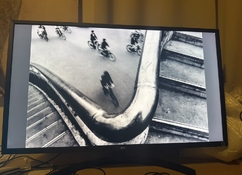
I found this interview excerpt, but I don't have the actual source:
“The 50mm corresponds to a certain vision and at the same time has enough depth of focus, a thing you don’t have with longer lenses. I worked with a 90mm. It cuts much of the foreground if you take a landscape, but if people are running at you, there is no depth of focus. The 35mm is splendid when needed, but extremely difficult to use if you want precision in composition. There are too many elements, and something is always in the wrong place. It is a beautiful lens at times when needed by what you see. But very often it is used by people who want to shout. Because you have distortion, you have somebody in the foreground, and it gives an effect. But I don’t like effects.”
Out of interest, I tried to find the original source. Google only brought Overgaard's (excellent) blogpost about HCB, from which you seem to have copied the slightly rephrased quote. "His" quote starts with "“The 50mm corresponds to". It is the only version starting with "The". So you seem to have copied his quote (without mentioning his website as a source).
ChatGPT helped to find the original source, where there quote starts with "It corresponds to...":
In June 2013, The New York Times published a two-part rediscovered 1971 interview between Sheila Turner-Seed and Henri Cartier-Bresson. The second part is titled “Henri Cartier-Bresson: ‘There Are No Maybes’” and includes the line you’re asking about — his explanation of why he preferred the 50 mm focal length: “It corresponds to a certain vision and at the same time has enough depth of focus…”.

Henri Cartier-Bresson: 'There Are No Maybes'
In 1971, Sheila Turner-Seed interviewed Henri Cartier-Bresson and other luminaries for a series of film strips that were lost until her daughter rediscovered them decades later.
archive.nytimes.com
Last edited:


 .
.