
-
Welcome to Photrio!Registration is fast and free. Join today to unlock search, see fewer ads, and access all forum features.Click here to sign up
Recent content by hsandler
-
 I bought a 1999 Fujifilm Instax 100AI scan them on a flatbed in an empty Instax film cartridge. It lifts the print surface just enough to avoid Newtons rings. And I like the black border. I would be leery of scanning a print through anti Newton glass. The glass is roughened and would tend to slightly blur the image. The way anti...
- hsandler
- Post #9
- Forum: Instant Cameras, Backs and Film
-
Sharpness of Instax with Lomograflok backADespite the 12lp/mm, it isn't too bad when properly focused. One problem is that the focusing spacer for the Lomograflok is plastic and perhaps not high precision. I usually stop down to at least f16 to get a little depth of focus. Results with a Lomograflok and any old view camera lens will be...
- hsandler
- Post #10
- Forum: Instant Cameras, Backs and Film
-
Zenza Bronica ETRS system opinions?AI had a fairly complete ETRSi kit. For doing verticals you really need the speed grip and a prism. Most lenses use 62mm filters. I ended up changing to an SQ-A system where you can get by without a speed grip and prism, and a lighter tripod can be used as no tilting required. Otherwise they are...
- hsandler
- Post #17
- Forum: Medium Format Cameras and Accessories
-
Instax photo collections?AOn a flatbed in reflective mode, you have a glossy print surface against glass. At high resolution settings (i use 1200 ppi) you can get Newtons rings. But putting the print into an empty Instax cartridge lifts it just off the glass and solves the problem. I apply a lot of unsharp mask after...
- hsandler
- Post #8
- Forum: Instant Cameras, Backs and Film
-
Instax photo collections?AI have mostly Instax wide prints, shot with Graflex cameras with a Lomograflok back. You can find physical albums for prints this size. I scan all my keepers and put the images in an online album on flickr. I scan the prints in an empty cartridge on a flatbed scanner. Instax works best with low...
- hsandler
- Post #5
- Forum: Instant Cameras, Backs and Film
-
Nikon F2 w/ AS-1 flash issueAThat should be best, but if too thick, try ordinary acetate tape.
- hsandler
- Post #4
- Forum: 35mm Cameras and Accessories
-
Describe your favorite memorable medium format shots and, hopefully, share the results or kit used.ASouris PEI light house at dusk. Bronica SQ-A, Fuji Provia. I won a photo contest at work with this, and the graphics department printed this up for me 24x24. Souris Lighthouse, PEI by Howard Sandler, on Flickr
- hsandler
- Post #19
- Forum: Medium Format Cameras and Accessories
-
Nikon F2 w/ AS-1 flash issueAOn some other old flash shoes where there is a lot of metal on the bottom of the shoe, the shoe shorts out the extra contacts on "smart" or brand-specific flash units or triggers. Try applying a bit of tape around the bottom of the shoe except for the edges and the centre contact to insulate the...
- hsandler
- Post #2
- Forum: 35mm Cameras and Accessories
-
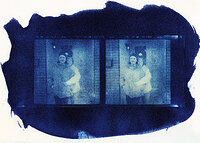 Cyanotype stereo cardACyanotype contact print of an adjacent pair of 6x6cm negatives from an Adox Golf 45S. The film travels left to right in this camera. By exposing the left image first, the pair comes out in the correct orientation to make a parallel stereo card by contact printing without cutting.
- hsandler
- Media item
- Comments: 0
- Category: Experimental Gallery
-
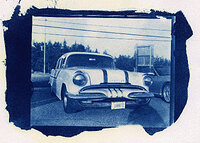 IMG_0025.jpegACyanotype from 4x5 negative.
- hsandler
- Media item
- Comments: 4
- Category: Standard Gallery
-
Vintage 120 Folders: Is there still a market for them?AFolders tend to be problematic, mainly bellows and parallelism of the front standard. There was a good article by Dante Stella a few years ago called "Folding up on folders" that can be found archived somewhere. I have had 6x9, 6x6 and 6x4.5 folders. I generally find the 6x4.5 size has the least...
- hsandler
- Post #10
- Forum: Medium Format Cameras and Accessories
-
How to (consistently) make positive E-6 transparencies with C-41 chemicalsAAfter a couple of duds, here is another example that worked. Ektachrome 100G expired 2002. Exposed as EI 12. I found it needs a strong black and white developer. D76 diluted 1:1 was a dud; didn't get much reversal. Here I used D76 stock at 38C for 10min. Fogged after the black and white step...
- hsandler
- Post #265
- Forum: Color: Film, Paper, and Chemistry
-
How to (consistently) make positive E-6 transparencies with C-41 chemicalsAI'm very late to the party, but perhaps this data point may be of interest. I acquired some 4x5 Ektachrome 100G from 2002 as part of a lot of expired film. So I stumbled onto this process, but all I have for the first developer is D76. Today I shot a sheet of the film at EI 64. Developed in D76...
- hsandler
- Post #263
- Forum: Color: Film, Paper, and Chemistry
-
Sironar or Symmar for field cameraAIf it's any help, I have a Sironar 240mm f5.6 in a Copal 3 shutter. The rear cone diameter is 68mm and the whole thing on a Pacemaker Graphic lens board weighs 900g. I have used it on a Crown Graphic without movements for portraits at a minimum of about 3m, like this one. It's front heavy, for...
- hsandler
- Post #36
- Forum: Large Format Cameras and Accessories
-
Graflex 6x9 120 Roll Holder RH10 RepairAFull marks for the attempts. "One must imagine Sisyphus happy" is the concluding line of Albert Camus's 1942 essay *The Myth of Sisyphus*, summarizing his philosophy of the Absurd. It suggests that despite the meaningless, repetitive nature of life (symbolized by Sisyphus pushing a boulder...
- hsandler
- Post #3
- Forum: Medium Format Cameras and Accessories
| Photrio.com contains affiliate links to products. We may receive a commission for purchases made through these links. To read our full affiliate disclosure statement please click Here. |
PHOTRIO PARTNERS EQUALLY FUNDING OUR COMMUNITY:  |