
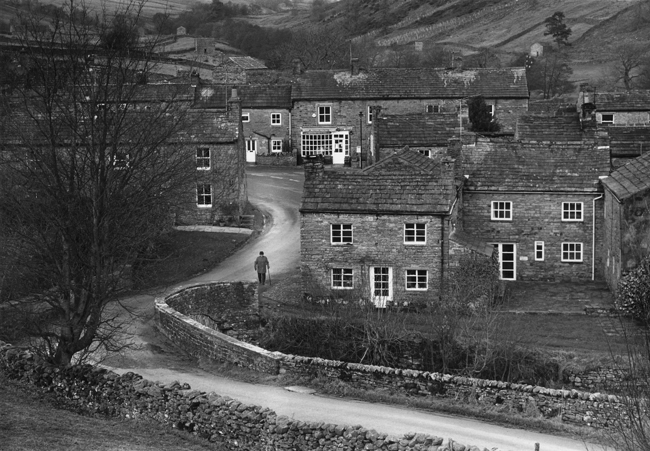


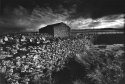
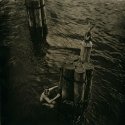
Another local scene showing something of the vernacular architecture of the area. Thwaite means 'clearing' in old Scandanavian _ I'm not sure now if its Norse or Viking. Mrs Alderson just happened to come along at more or less the right moment.
This is more or less a straight print and any suggestions or improvements through local contrast control would be much appreciated.
Well - actually... that'd be DANISH, wouldn't it?? Just like all the towns whose names end in -by in England from the Danish conquest of 800 AD or whenever it was...?
As with the other images you uploaded, I find it a little on the dark side for my taste. This one in particular, I took the liberty of copying to my PC and lightened it in an image editor (no names, no pack-drill... ) and think it gains a lot if printed lighter: especially the left hand side behind the tree loses its somewhat muddy feeling. Point is, that's only *my* taste: if you think this print represents your view of the village, then that is really all that matters.
BTW, I have already given the good folks here a lesson on the origins of the name "Thwaite" (http://www.apug.org/gallery/showphoto.php?photo=17223&cat=500&ppuser=2807) - (it's Old Norse/Old English apparently)...
At the same time as the shot referenced above, I did take some shots of Thwaite itself from a little lower down from where you are here but none were anywhere near as good as this one and I've never printed them...
Cheers, Bob.
P.S. Unfortunately, Wikipedia is of little use in this matter. "Danish" as a distinct language did not exist at that time: people from what is now Denmark spoke Old Norse, as I believe did the rest of Scandinavia (though no doubt there were local dialects within the region - the phrase "East Norse" rings a bell, but I can't remember the context).
Place names in England are harvested from a wide range of incomers including Celtic, Anglo-Saxon, Old Norse and Norman French, many place names being twisted by local dialect and custom into words more easily pronounceable by the locals and thereby losing their origins.
In practice, Anglo-Saxon place names are found widely in Southern and Eastern England with Old Norse names appearing more commonly in Northern and North Western areas. However, for every rule there are innumerable exceptions and only an expert (of which I am certainly not one) on the subject could unravel the variations...
Your image already has an S shaped curve working for it. It would benefit from a greater amplification of a depiction of the repetitive patterns of the roofs of the structures. This could be accomplished by split grade printing this image and burning down the roofs at a higher contrast grade. Beyond that, to create depth in your image, amplify the atmospheric depiction of distance by bringing up the tonal values of the distant landscape.
You need to crop just a hair off the bottom of the image to remove that little tiny post coming up into the white road area in the bottom right corner. That little piece is VERY distracting and should not be there.
Many thanks for all of the comments and for taking the time and trouble to make them so detailed. Much appreciated.
I'll try to resist fanning the flames of the name derivation topic other than to suiggest that there seems to be some consensus that 'by' endings seem most likely to be old Danish and therefore Viking. Thwaite or 'Thveit' is probaly old Scandanavian but whether that is Danish or Viking Norse seems less certain today and a quick google search throws up both possibilities.
Bob re darkness and tonality - yes, the tree is the real problem for me in this image. The gap through which you can see this scene is quite narrow, as you seem to have discovered while hunting for a photography here yourself. I don't really know what to do in terms of manipulation, as I'd really like the building behind to stand out much more.
Donald. Your suggestion re the valley background has got me thinking. I'd tried to compress this area to make the group of elevations more two dimensional by burning the background in a little more to marry with the tones of the stonework. Creating depth rather than a narrow field may wel be beneficial.
Ryan. What can I say? I'd never really taken in the top of the post. Now you point it out to me I can't take my eyes of it. It seems very distracting and yet so easy to remedy.
You could make the LH building stand out more by increasing contrast in that area - if you dodge the area during the main exposure and then burn in at a hard grade that should achieve the effect you want by lightening the building and darkening the tree. Personally I'd darken the top slightly too. Are you sure you didn't ask Mrs Alderson to pose in that perfect spot?!
Photrio.com contains affiliate links to products. We may receive a commission for purchases made through these links. To read our full affiliate disclosure statement please click Here.
PHOTRIO PARTNERS EQUALLY FUNDING OUR COMMUNITY:

This site uses cookies to help personalise content, tailor your experience and to keep you logged in if you register.
By continuing to use this site, you are consenting to our use of cookies.