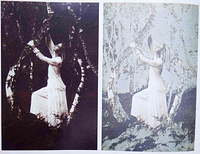
when one photographs a daguerreotype it needs to be lighted ( lit? ) in a certain way
do you have to rephotograph this as a straight print to get this image not to "shift to the other one"
is there a way to show what the shifted / metallic image looks like ? I'm guessing that it looks almost like a negative
but not really... and did it change appearance since you made it ?
really beautiful photograph! john
The print above, Woodland Tranquility is not a 'spatio kinetic' print. It only has one visualisation as above.
In answer to your question, spatio kinetic prints showing two visualisations from the same print, and a gradual transformation between the two, have to be re-photographed from two different angles to achieve a record of the two states. The only record I have of such a print, photographed by Tim Spridell from two different angles (until I do some more), are the photographs reproduced in the BJP article The Kinetic Tin Process (1993)
thanks for the into !
i had a feeling it had to be photographed 2x's
whats the difference between a spacio kinetic print and a kinetic tin processed print?
i was under the impression they were the same, if not similar ...
Just my quirky teminology! However a spatio kinetic print may be produced by any means that intentionally shows more than one visualisation with different viewing angles. Daguerrotypes are accidentally spatio kinetic - they just do that anyway. B&W silver gelatine prints on Ilford MGIIIFB do not normally show strong deliberately engineered spatio kinetic properties unless they have been processed using very specialised toning or development systems. So - a FB B&W print having spatio kinetic properties produced specifically using the kinetic tin process is a 'kinetic tin processed print', if you follow my reasoning ;-)
Photrio.com contains affiliate links to products. We may receive a commission for purchases made through these links. To read our full affiliate disclosure statement please click Here.