

I love cameras from this era; they are the opposite of “point and shoot,” and for me that’s precisely what makes using them so enjoyable.
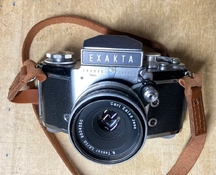
This copy was built in 1962.
I bought the camera from an antiquarian who, in turn, had acquired it from a well-established family in Burgos (Spain); one of its members had purchased it—very likely in France—in the early sixties.
The lens is marked as high-quality (a 1 inside a capital Q): a Carl Zeiss Jena 50mm f/2.8.
The camera arrived with its usual pinholes and a closing curtain that wouldn’t work below 1/50, probably due to decades of disuse. The lens showed some external and internal dust, along with a small amount of fungus.
However, the lens is perfectly collimated.
After a thorough external cleaning of both camera and lens, and after masking the pinholes with paint, the shutter began working at all speeds. Not at the marked values, of course, but once you know the actual speeds it becomes perfectly usable by “translating” the readings from an external light meter.
I’m very pleased with the images it produces—so much so that I’m no longer sure it’s even worth opening the lens to clean the internal elements.

This copy was built in 1962.
I bought the camera from an antiquarian who, in turn, had acquired it from a well-established family in Burgos (Spain); one of its members had purchased it—very likely in France—in the early sixties.
The lens is marked as high-quality (a 1 inside a capital Q): a Carl Zeiss Jena 50mm f/2.8.
The camera arrived with its usual pinholes and a closing curtain that wouldn’t work below 1/50, probably due to decades of disuse. The lens showed some external and internal dust, along with a small amount of fungus.
However, the lens is perfectly collimated.
After a thorough external cleaning of both camera and lens, and after masking the pinholes with paint, the shutter began working at all speeds. Not at the marked values, of course, but once you know the actual speeds it becomes perfectly usable by “translating” the readings from an external light meter.
I’m very pleased with the images it produces—so much so that I’m no longer sure it’s even worth opening the lens to clean the internal elements.