

• Welcome to Photrio!
    Registration is fast and free. Join today to unlock search, see fewer ads, and access all forum features.
    Click here to sign up

ECN2 film base color off and developer pH

Fire escape.

H
Fire escape.

  • 2
  • 1
  • 16
22886.jpg

A
22886.jpg

  • 2
  • 0
  • 32

Recent Classifieds

Forum statistics

Threads
204,343
Messages
2,867,393
Members
102,231
Latest member
kimlee2027
Recent bookmarks
0

Alain Deloc

Member
Joined
Sep 16, 2018
Messages
123
Location
Bucharest
Format
Multi Format
Hi everyone,
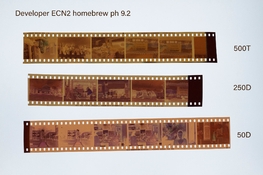
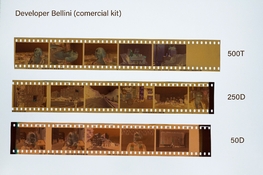
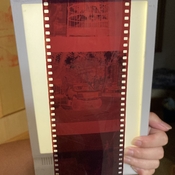
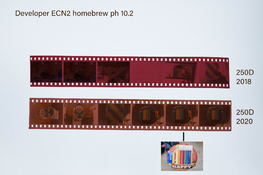
I have mixed my own ECN2 chems over the last 3 years. However, last time I noticed that ny ECB2 dev had a pH 9.2 after 3 rolls of film (one 50D, 250D and one 500T). I think that's because of sodium carbonate which has built some bicarbonate in it. Anyway, I raised up the pH to 10.2 using few grams of NaOH. I tested the developer using 2 strips of Vision3 250D, one from 2018 and the other from 2020. The negatives shown a red-pink base and quite a lot of density. I am attaching now 3 comparisons, one of them having the tests, another one having some strips before changing the developer pH and few strips made some years ago with Bellini ECN2. Does anyone know what can produce that weird effect or what happened?

(I have to mention that the red-pink films not that bad after scanning and conversion. The colors are quite saturated and the positives seems overdeveloped, but it can be corrected easily)

Thanks!
 

Attachments
  • _MG_0935_edit.jpg
    _MG_0935_edit.jpg
    346.7 KB · Views: 353
  • _MG_0936_edit.jpg
    _MG_0936_edit.jpg
    289.2 KB · Views: 384
  • _MG_0938_edit.jpg
    _MG_0938_edit.jpg
    297.8 KB · Views: 336
Last edited:
Does anyone know what can produce that weird effect or what happened?

Possibly a non-calibrated pH meter bring way off. Most cheap pH meters are pretty much worthless especially after a few months.
It's also possible you have another problem elsewhere in the process and the suspicion of the developer is just a fluke. You'd have to do some comparison testing to isolate the exact cause.
 
Possibly a non-calibrated pH meter bring way off. Most cheap pH meters are pretty much worthless especially after a few months.
It's also possible you have another problem elsewhere in the process and the suspicion of the developer is just a fluke. You'd have to do some comparison testing to isolate the exact cause.

I am using a Hanna pH meter. Buffer solutions are giving the right values. Also, same developer was used few days ago to produce the strips from the comparison with title "Developer pH 9.2" . The red base appeared after NaOH addition.
 
Never measured until now. I was usually mixing the chemistry and then just use it. But I had the impression that my negatives are lacking some shadow details, so I started to investigate what's happening.
 
Then your answer is probably that this developer somehow performs reasonably well at a surprisingly low pH. Which formula do you use exactly?

Btw, the 50D strip with the DIY developer at pH9.2 looks quite normal to me. All the others are pretty far off in terms of orange mask. It's evidently way too magenta and too dense in the high pH strips. The 250D and 500T lack seriously in magenta in both your low pH DIY developer and the Bellini kit. The 250D I've been using looks just like the 50D in terms of base color. Is your film very much expired or something?

Given the differences between the 50D and the other films in your comparisons, there must be something going in here that isn't quite right. Not sure if it's just the developer.
 
I don't think the red-pink film is an effect of developer.I had a similar problem once.

My prebath is taking too long and the temperature is too high. When I was in the prebath, I filled the developer tank with hot water, after which I went to the toilet for about 10 minutes. Then the film I developed turned into red-pink
This surprised me, to see if my chemicals had been mixed wrong or failed, I immediately cut out a short piece of film, then developed it with the same potion, and found that everything was fine. The only difference between is the prebath time.
 

Attachments

  • IMG_7894.JPG
    IMG_7894.JPG
    1.1 MB · Views: 212
And then you did another test with 10min prebath to verify that long prebath really is the cause for the red-pink colour of the film?
 
Last edited:
I've done lots of variations with holding color film in a tempered water bath prior to development. It doesn't make any difference in color balance and it definitely doesn't skew ECN2 base color this way. The cause is elsewhere in the process.

I'm currently processing a batch of ECN2 film and the time of the remjet removal bath, rinses and tempered water pre-bath all varied significantly with none below a few minutes or so. The base color is the same on all films and completely normal.

Massive shifts in base color would be caused by variations in the actual development stage, problems with bleach and fogging to light (although that tends to be more uneven).
 
I once had a similar case. I use Kodak's official borax-sulfate formula (PB-2). Perhaps (I don't know how much) an important point is that this formula is given at a low temperature and for only 10 seconds. But I did a (mistake?) bath at 41 degrees for about two minutes by mistake. High temperatures and long times are not required to dissolve rem-jet adhesives (contrary to expectations, longer time does not translate into better rem-jet removal). My guess is that the alkaline solution remained in the emulsion until the developer was poured in, acting as a starter. I haven't retested and can't confirm right now that it's from this, but I always do a very good wash between the stop bath and the bleach, including a sulfite intermediate step (I use sulfuric acid for the stop bath and I have no idea if it is appropriate to put sulfite in it, that's why I make a separate cleansing bath).
 
My guess is that the alkaline solution remained in the emulsion until the developer was poured in, acting as a starter.

Carry-over problems are possible. I think it's good practice to follow the remjet removal bath by a thorough wash; I generally use 3-5 rinse cycles. Note that the remjet removal step in the Kodak-suggested machine design involves multiple water jets, so extensive washing (as well as mechanical removal of the remjet material):
1685356611657.png


1685356645694.png


Btw, the pH of the Kodak-prescribed pre-bath is listed as 9.25. This is significantly lower than the ECN2 developer. As such, carry-over of this bath should result in underdevelopment if pH is the issue. It's of course conceivable that there's an additional chemical interaction going on. I'm no chemist, so I can't comment on that.
 
Yes, I know the Kodak rem-jet cleaning technique, but it is not applicable at home. My procedure is 10-20 seconds in PB-2 with no stirring, then 4-5 water baths with strong and constant shaking until the rem-jet residue stops coming out. This cleans almost everything except for a very thin layer that I mechanically remove at the end.
I also have a stock of Fuji film - with it the rem-jet looks like ink, which dissolves completely very quickly and does not require mechanical intervention.
 
the Kodak rem-jet cleaning technique, but it is not applicable at home

Well, it applies to home users to the extent that:
* Adequate washing is required between the remjet softening prebath and development
* Mechanical removal of remjet remains is required with Vision3 films
 
Yes, unfortunately, without mechanical cleaning of rem-jet there is no way. Not that it's a particular problem, but sometimes particles remain on the emulsion, no matter how careful I am...
 
Yes, it's annoying since mechanical removal always carries the risk of damage to the film. To make matters worse, some of the remjet tends to find its way to the emulsion layer whenever I process ECN2 so I have to resort to mechanically cleaning that side as well, which is even more risky!
 
Hi everyone,
I have mixed my own ECN2 chems over the last 3 years. However, last time I noticed that ny ECB2 dev had a pH 9.2 after 3 rolls of film (one 50D, 250D and one 500T). I think that's because of sodium carbonate which has built some bicarbonate in it. Anyway, I raised up the pH to 10.2 using few grams of NaOH. I tested the developer using 2 strips of Vision3 250D, one from 2018 and the other from 2020. The negatives shown a red-pink base and quite a lot of density. I am attaching now 3 comparisons, one of them having the tests, another one having some strips before changing the developer pH and few strips made some years ago with Bellini ECN2. Does anyone know what can produce that weird effect or what happened?

(I have to mention that the red-pink films not that bad after scanning and conversion. The colors are quite saturated and the positives seems overdeveloped, but it can be corrected easily)

Thanks!

I also did prebath for too long and too hot and images came out pink/purplish. When I strictly monitered the prebath time, temperatue, and temperature of washes, film base turned to typical ECN-2 color. Can we see the scans of this red base film? I'd love to compare it to what mine turns out to be like. I'm kind of worried I ruined my vacation pics.
 
Welcome aboard @grainbow!
Prolonged time in the prebath won't affect the negatives. What can affect the development is if the wash between the prebath and the developer is left out.

Can we see the scans of this red base film?

If you show yours, others may be able to say something about them. It would help if you show a strip of the affected film side by side with a properly processed strip of the same film.
 
I once had a very strange problem - I couldn't recreate it, but I still think it was a combination of high temperature + long time in the pre-bath. Also, the film was held for 10 minutes after the pre-bath in a 40 degree water bath before I started the developer. The negative didn't look too bad to the eye, but something terrible had happened to the dyes.
 
Prolonged time in the prebath won't affect the negatives.

Might depend on what (and how) is used for prebath. Some people use driveway cleaners or whatnot for prebath...

I once had a very strange problem - I couldn't recreate it, but I still think it was a combination of high temperature + long time in the pre-bath. Also, the film was held for 10 minutes after the pre-bath in a 40 degree water bath before I started the developer.

If long water bath after remjet removal was the problem, I'd have probably ruined every ECN-2 film I've ever processed.

I use remjet removal solution at room temperature, wash thoroughly and then gradually bring tank and film temperature to 41ºC with water baths. Might not take me 10min every time but it's definitely more than 5min.
 
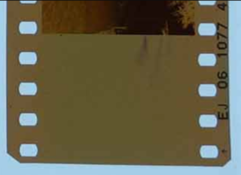
I really have no explanation for what happened. The film is fresh, from a 400-foot roll - the same ones came out normal. The development was as usual - the difference was that I inadvertently heated the bath to 41 degrees and just as I started, I got a call for an important conversation. So I stayed in the pre-bath for about 2 minutes, and then about 10 minutes in the water until I finished the conversation. On the light board the film doesn't look bad. But it can't be scanned. On closer inspection - you can see how the dyes "pour" out of the dark areas - just some kind of absurdity.
 

Attachments

  • 1735991154966.png
    1735991154966.png
    82.1 KB · Views: 97
Might depend on what (and how) is used for prebath. Some people use driveway cleaners or whatnot for prebath...

Yeah, although even in that case, it's not a given that the film will suffer. Kodak Vision3 is pretty darn tough. Assuming a prebath made of something sensible like a borate buffer, a carbonate solution etc. - no, leaving the film in there for 10 minutes won't do much. Provided it's washed afterwards; otherwise carryover from the prebath of course will affect development.

you can see how the dyes "pour" out of the dark areas

That's related to either some form of contamination, or a light leak issue. If it's contamination, the direction of the spread (fanning out lengthwise along the length of the film) suggests it's not something that happened as the film was sitting still in a typical tank & reel, since the orientation is perpendicular to what you'd get in that case.
The first thing that comes to mind is that you have an issue with undissolved developer. Under some circumstances, CD3 can coagulate in small globules when it's added to the ECN2 developer as the final ingredient. This can be prevented by dissolving the CD3 in a little water, and then adding that solution to the developer. Another possibility is that the prebath was contaminated with something, although given the orientation of the defect, this seems less logical (see above).
The green coloration on the film base in the marked area below looks like underfixed film btw. Fix it again and see if that clears up the color problems. This won't fix the 'comets' of course.
1735992194872.png

Your problem doesn't seem related to a prolonged soak in an otherwise functional prebath.
 
It's fixed well, I just took a picture with my phone and with the glare of strong light from the window.
I've tried it with re-bleached and fixed - no change. The pre-bath was used before without any problems, the developer was also reused. AFTER the problem, I did a series of tests, including with the chemicals I had left after the problem. I still couldn't simulate it...
 
Photrio.com contains affiliate links to products. We may receive a commission for purchases made through these links.
To read our full affiliate disclosure statement please click Here.

PHOTRIO PARTNERS EQUALLY FUNDING OUR COMMUNITY:


Ilford ADOX Freestyle Photographic Stearman Press Weldon Color Lab Blue Moon Camera & Machine
Top Bottom