



Andreas Thaler
Subscriber
The number of books on repairing SLRs published before the year 2000 is fairly limited.
Here, I’d like to highlight a few classics that no library should be without.
None of these works are available in print anymore; two books by Thomas Tomosy are available on Amazon for Kindle, so you’ll have to check with retailers.
The search—and even the sometimes high prices—are always worth it. This is essential knowledge, straight from the masters of their time.
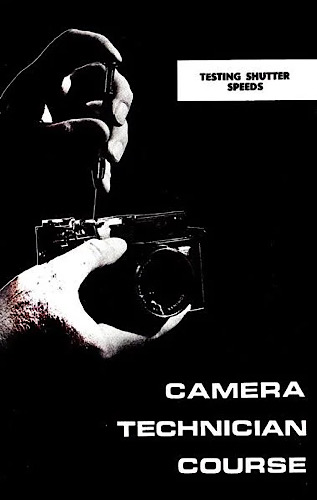
National Camera (NatCam) in the US offered a self-study correspondence course for aspiring repair technicians.
Students learned from scripts, worked on practical assignments, and submitted exam papers for correction. Successful graduates received a certificate that was highly regarded in the industry.
This course no longer exists today. But the scripts are available.
The publications range from the early 1970s to the early 1980s. A list of topics can be found here. In addition, there are scripts on other topics not listed here.
The knowledge imparted is among the best available today
Even though technology has advanced in the meantime, the technology of the photographic equipment we want to repair from that period has remained the same.
Here and there, it just needs to be brought up to date. For example, multimeters for measuring electrical values have become easier to use today. The same applies to oscilloscopes. Much more powerful devices are also available today for testing electronic components.
Anyone who is serious about DIY cannot do without these publications.
Available on Learn Camera Repair, and as hard copies at retailers.
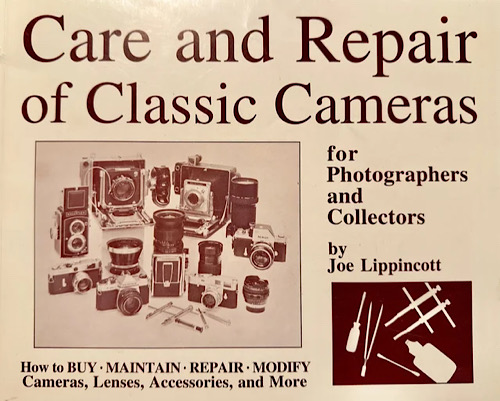
There are a limited number of books on the subject of camera repair, at least in English and German.
One highlight is Care and Repair of Classic Cameras by Joe Lippincott, published in 1999.
It is a veritable treasure trove of information on the subject and covers cameras of various formats. Written in a clear and understandable style and illustrated, this book is recommended for both beginners and advanced readers.
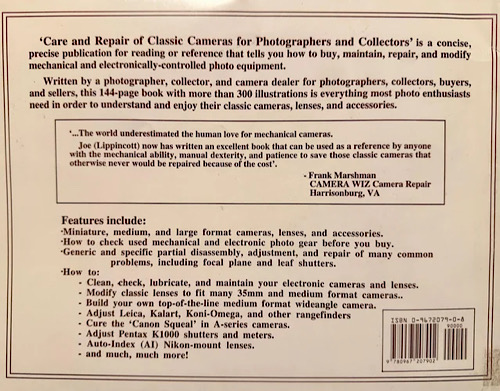
Practical application is the main focus here, with numerous tips and hints that are useful even if you don't work with the camera discussed in each case. Technology and theory complement each other and make the book an exciting read.
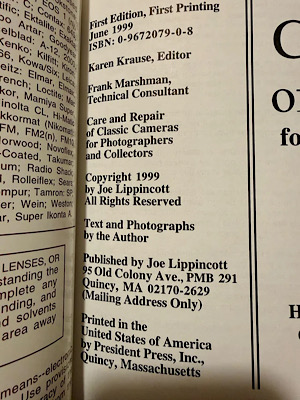
When I bought the book some time ago, it was not easy to find. But it's worth the search!
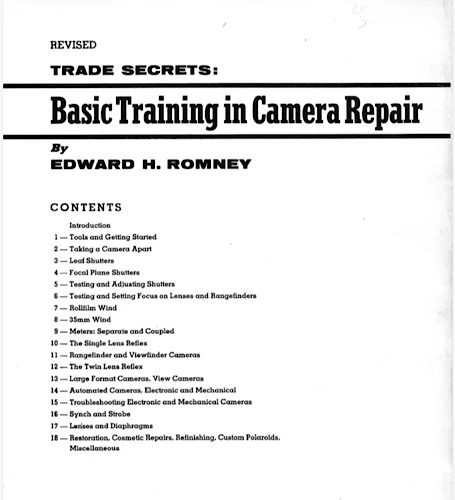
Basic Training in Camera Repair, published 1979
Literature on technical topics does not always have to be abstract and written only for readers with prior knowledge. It can also be entertaining without making the content any less informative. This is important, especially when addressing beginners to the subject.
Edward H. Romney, who has written several publications on camera repair, is a master of this art of writing.
Lively, direct, unconventional, and always vivid, his work takes readers on a journey through the wide world of different camera systems.
Practical tips are provided in every paragraph, sometimes in a jumpy manner but always useful for the reader. Illustrations and drawings complement the text.
A refreshing read in a field where there are few publications.
Romney’s publications are not easy to find, but well worth the search!
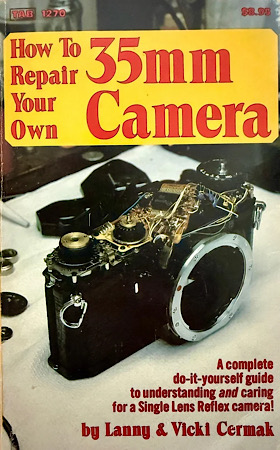
This book was published in 1981 and was written by two Vivitar employees.
It is a comprehensive guide to assessing, cleaning, and repairing 35mm cameras, with a particular focus on the technology of the individual sections of an SLR.
Numerous illustrations and practical tips make the book accessible even to beginners and enrich the know-how of advanced users.
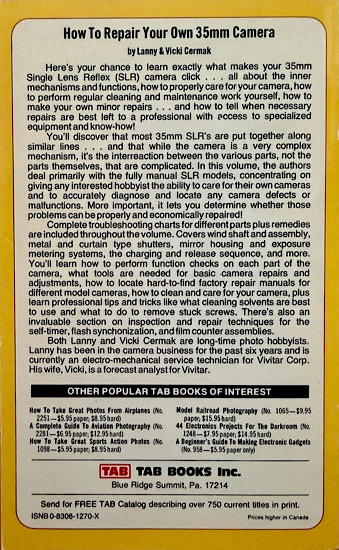
Further information on the content can be found on the photo showing the text on the back cover of the book.
Like most classics on the subject, this book is not easy to find in print. But here, too, it's worth searching.
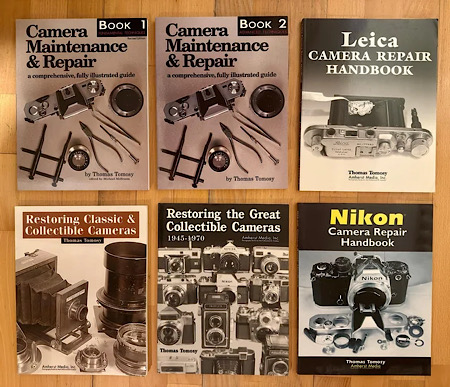
Many people interested in camera repair have entered this fascinating field with books by Thomas Tomosy. The two volumes Camera Maintenance & Repair, published in the late 1990s, are considered classics and are a must-have for any specialist library.
All six books from Amherst Media are lavishly produced with photos and an appealing layout, making them enjoyable to read. Thomas Tomosy writes in a practical style, without neglecting the theory.
Unfortunately, all books are out of print and rare. The prices are correspondingly high. Camera Maintenance & Repair 1 and 2 are available on Amazon for the Kindle.
As with all publications on the subject of camera repair, it's worth searching for them!
See also

 www.photrio.com
www.photrio.com
Here, I’d like to highlight a few classics that no library should be without.
None of these works are available in print anymore; two books by Thomas Tomosy are available on Amazon for Kindle, so you’ll have to check with retailers.
The search—and even the sometimes high prices—are always worth it. This is essential knowledge, straight from the masters of their time.
National Camera (NatCam) in the US offered a self-study correspondence course for aspiring repair technicians.
Students learned from scripts, worked on practical assignments, and submitted exam papers for correction. Successful graduates received a certificate that was highly regarded in the industry.
This course no longer exists today. But the scripts are available.
The publications range from the early 1970s to the early 1980s. A list of topics can be found here. In addition, there are scripts on other topics not listed here.
The knowledge imparted is among the best available today
Even though technology has advanced in the meantime, the technology of the photographic equipment we want to repair from that period has remained the same.
Here and there, it just needs to be brought up to date. For example, multimeters for measuring electrical values have become easier to use today. The same applies to oscilloscopes. Much more powerful devices are also available today for testing electronic components.
Anyone who is serious about DIY cannot do without these publications.
Available on Learn Camera Repair, and as hard copies at retailers.
There are a limited number of books on the subject of camera repair, at least in English and German.
One highlight is Care and Repair of Classic Cameras by Joe Lippincott, published in 1999.
It is a veritable treasure trove of information on the subject and covers cameras of various formats. Written in a clear and understandable style and illustrated, this book is recommended for both beginners and advanced readers.
Practical application is the main focus here, with numerous tips and hints that are useful even if you don't work with the camera discussed in each case. Technology and theory complement each other and make the book an exciting read.
When I bought the book some time ago, it was not easy to find. But it's worth the search!
Basic Training in Camera Repair, published 1979
Literature on technical topics does not always have to be abstract and written only for readers with prior knowledge. It can also be entertaining without making the content any less informative. This is important, especially when addressing beginners to the subject.
Edward H. Romney, who has written several publications on camera repair, is a master of this art of writing.
Lively, direct, unconventional, and always vivid, his work takes readers on a journey through the wide world of different camera systems.
Practical tips are provided in every paragraph, sometimes in a jumpy manner but always useful for the reader. Illustrations and drawings complement the text.
A refreshing read in a field where there are few publications.
Romney’s publications are not easy to find, but well worth the search!
This book was published in 1981 and was written by two Vivitar employees.
It is a comprehensive guide to assessing, cleaning, and repairing 35mm cameras, with a particular focus on the technology of the individual sections of an SLR.
Numerous illustrations and practical tips make the book accessible even to beginners and enrich the know-how of advanced users.
Further information on the content can be found on the photo showing the text on the back cover of the book.
Like most classics on the subject, this book is not easy to find in print. But here, too, it's worth searching.
Many people interested in camera repair have entered this fascinating field with books by Thomas Tomosy. The two volumes Camera Maintenance & Repair, published in the late 1990s, are considered classics and are a must-have for any specialist library.
All six books from Amherst Media are lavishly produced with photos and an appealing layout, making them enjoyable to read. Thomas Tomosy writes in a practical style, without neglecting the theory.
Unfortunately, all books are out of print and rare. The prices are correspondingly high. Camera Maintenance & Repair 1 and 2 are available on Amazon for the Kindle.
As with all publications on the subject of camera repair, it's worth searching for them!
See also
Technical literature for camera repairs
The number of English-language specialist publications on newer (SLR) cameras repair is manageable. I think I have compiled the most important titles here: The Camera Craftsman, SPT Journal and SPT Service Notes were published periodically. Editions of repair/service manuals, C & C...
www.photrio.com
How-to guide DIY service/repair for electromechanical SLRs: Where can I find information on repairing specific cameras? (part 5/8)
Excerpt from an issue of the SPT Journal. Fortunately, all the information we need for servicing and repairing our electromechanical SLRs is available on the web. Some of it is free, some of it is paid. The first port of call for information is learncamerarepair.com (LCR) Many issues of the...
www.photrio.com
Last edited:
