Matt.
As I'm sure you know, reciprocity failure of the type we are discussing here - Low Light Intensity Reciprocity Failure ("LLIRF") is actually not related to the length of exposure at all. It is related to the intensity of the light that reaches the film. We tend to think of it in relation to exposure times because lengthening the exposure time is the tool we tend to apply when we are dealing with that low light intensity.
Les' test exposures don't get into reciprocity failure territory because, while they include under-exposed film, even that film is being exposed to fairly bright light - just for a bit less time than would result in correct exposure.
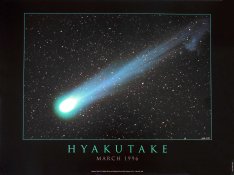
You are photographing the stars and other things up in the skies. By the time it gets to your film, that light is dim! So that is why you have to deal with LLIRF.
Push processing works with slide film because of a bunch of technical reasons that relate to the fact that what we see in a transparency is actually an image of the parts of the emulsion that were originally exposed in camera, but were not developed into an image. Essentially, you are seeing what is left over after the first development is finished, and then bleached away. The combination of the develop, bleach, redevelop process is what gives you a sensitivity boost from push processing of transparency film. Without those additional steps, C-41 film doesn't gain sensitivity.
IIRC, the early moon shot photos were on negative films, cross processed as slides, because of a number of factors, including that potential boost in sensitivity. I don't know whether that might be an approach that would help you.
FWIW, there is also High Light Intensity Reciprocity Failure ("HLIRF") - we most often see that with high power flashes, used at close distances.




 Kodak Portra 400 exposure range
 Fuji 100 long exposure
 Gold 100 long exposures
 Kodak Portra 400-11-31
 Kodak Portra 800-06_22B
 Kodak Ektar 100_37-31B
 IMG_20160703_223609044
 IMG_20150118_202603725

