



• Welcome to Photrio!
    Registration is fast and free. Join today to unlock search, see fewer ads, and access all forum features.
    Click here to sign up

Designing A Multimeter (PW-June-1965), by K. Berry, presented by Peter Vis

Old shed

Old shed

  • 0
  • 0
  • 0
Marloes

A
Marloes

  • 0
  • 0
  • 0

Forum statistics

Threads
204,383
Messages
2,867,716
Members
102,241
Latest member
leoxiaowoniu
Recent bookmarks
0

Andreas Thaler

Subscriber
Joined
Nov 19, 2017
Messages
5,208
Location
Vienna/Austria
Format
35mm
Multimeters are essential measuring instruments whenever an SLR has a power supply on board.

Anyway not everyone knows exactly how a multimeter works.
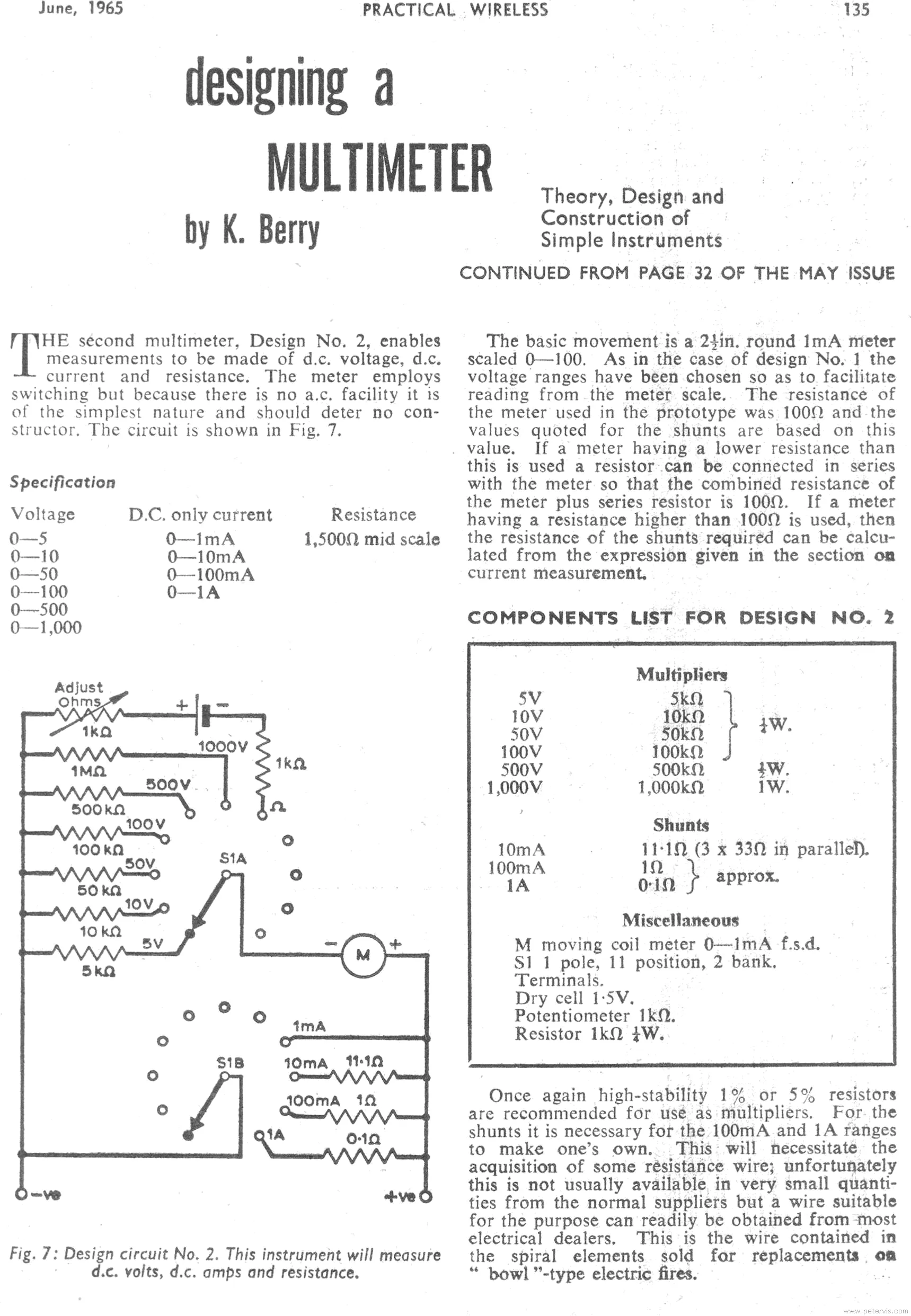
This article shows the basics of designing and building a simple multimeter. It is one of those wonderful beginner and hobbyist projects, which allows one to make their own simple measuring instrument.


Please note that this article is intended for informational purposes only. Unless you have a solid understanding of electronics, I advise against using a homemade multimeter to measure high voltages, as such a device is not certified for safety.

Therefore please keep this safety warning in mind:

+++

⚠️ A word of caution

Dangerous high voltages can be present when handling electronics, especially in conjunction with electronic flash units and mains. Therefore, familiarize yourself with the safety regulations beforehand and ensure your safety.

All information provided without guarantee and use at your own risk.
 
Ah, those were the times (before I was born) were it was OK to tell a beginner to built himself a voltmeter for up to 1000V 😲 💀.

Multimeters are essential measuring instruments whenever an SLR has a power supply on board.

Anyway not everyone knows exactly how a multimeter works.
To be precise, the article shows how a passive, analog multimeter works. I would suggest to not use this "ancient design" multimeters in SLR repair, maybe except for measuring the voltage of the battery. The problem is the "passive" nature of these multimeters, that is, the signal is measured directly without any amplification. This results in a low input impedance. For example, in the Design 2 multimeter described in the article the input impedance is 1kOhm/Volt. If you use its 10V range (should be sufficient for all voltages in an SLR except for flashes) the input impedance is 10kOhm. That means, whenever you measure a voltage, you put a 10kOhm resistor in parallel to the circuit. Especially in low-current circuits like in SLRs this will influence the measurement considerably, the voltage will drop and you will measure a value that is too low. This can result in the false assumption that something is wrong with the circuit. You could consider this as a macroscopic form of Heisenberg's Observer Effect.

Therefore, you should use an active multimeter for SLR repair that has at least 1MOhm (better: 10MOhm) of input impedance. The extra load put on the circuit by these multimeters is so small that it becomes irrelevant for practical use. Whether you use an analog or digital multimeter is up to your taste. Sometimes, analog multimeters are better in showing fast-changing voltages, often, digital multimeters are more convenient. I use both:
  • A vintage active, analog multimeter I refurbished (Philips PM2505) with input impedance of 10MOhm.
  • A modern digital multimeter (Brymen BM257s) with input impedance of 10MOhm.
Both can be used to measure up to 1000V DC without the danger of dying 😉.
 
As I said, this is just about how a multimeter works in principle, not about building one from scratch.

What you see here is analog technology that is now outdated. But the basic principles remain the same, and this is the easiest way to demonstrate them.

For actual work, I would only use a modern digital multimeter.
 
this is just about how a multimeter works in principle
Only this particular type, which is no longer being made or used. More modern solutions of course also involve Ohm's law at some point.

to built himself a voltmeter for up to 1000V
Then again, back in those days, you needed that voltage range!
 
Only this particular type, which is no longer being made or used. More modern solutions of course also involve Ohm's law at some point.

When it comes to demonstrating, in general terms, how to convert electrical quantities such as voltage, current, and resistance into a readable display, this description at this component level is clear. However, this requires knowledge of analog electronics.

Due to its complexity, a modern digital multimeter can now only be represented at the block-level. But it can only function based on the fundamentals of analog electronics, which, after all, do not change. Digital electronics, too, is built upon these analog fundamentals.

Which approach works best for you depends on your level of knowledge. The good thing is that you can scale down your analysis of circuits. Otherwise, I’d have to try to understand in detail the interconnections of a huge number of transistors in a microprocessor. A ticket to madness 😝
 
[1,000 volts]

Then again, back in those days, you needed that voltage range!

Probably for measuring cathode-ray tubes in monitors, but these days I’d have to go to a substation with a multimeter to measure such voltages as AC 😝

1,000 volts DC—where can I find that nowadays? 230 VAC is the standard household voltage in the EU.
 
Photrio.com contains affiliate links to products. We may receive a commission for purchases made through these links.
To read our full affiliate disclosure statement please click Here.

PHOTRIO PARTNERS EQUALLY FUNDING OUR COMMUNITY:


Ilford ADOX Freestyle Photographic Stearman Press Weldon Color Lab Blue Moon Camera & Machine
Top Bottom
