
View attachment 118
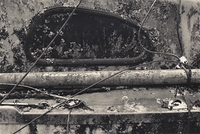
I was curious to see "where" the black ink actually kicked in with my printer and its settings. So I used my scanner in film mode to scan the HSL Array and actually look at the dots on the page. It helps if you crank the sharpness and contrast up a bit. It's really incredible that you can actually see the dots. What you see posted above is a slice of the 60 Degree (pure Yellow ink) column. It's pure yellow until it hits the mid-point at (RGB 255,255,0) then as it drops in brightness the driver introduces what looks to me like Light Cyan and Light Magenta for the first two or three steps. Then after than it looks like regular Cyan and Magenta are added for the next eight steps. Then finally at 60H100S45B on the HSB scale you can see the black ink actually starts to take over. This is where the driver slowly starts to curve in the K ink until the end where it is mostly black. You might be able to also see just a bit of the next column over -- the 65 Degree Hue -- noteworthy to say that the black ink seems to kick in one step earlier (at 50Brightness) in that colour. So each colour would have to be accessed individually.
So my thinking is that is someone wanted to stay in just the CMY range, avoiding the K for contrast or grain reasons, they're actually safe until they approach the last quarter of the Array, until the Brightness drops somewhere near the 45 value (remember this Array uses steps of five). Below the 45 value the ink gets a bit more prone to looking banded. Nobody says you can't print in this range if you have to, well not me anyway, but you're trading density for grain blocking up. An old story in photography.
~m
I was curious to see "where" the black ink actually kicked in with my printer and its settings. So I used my scanner in film mode to scan the HSL Array and actually look at the dots on the page. It helps if you crank the sharpness and contrast up a bit. It's really incredible that you can actually see the dots. What you see posted above is a slice of the 60 Degree (pure Yellow ink) column. It's pure yellow until it hits the mid-point at (RGB 255,255,0) then as it drops in brightness the driver introduces what looks to me like Light Cyan and Light Magenta for the first two or three steps. Then after than it looks like regular Cyan and Magenta are added for the next eight steps. Then finally at 60H100S45B on the HSB scale you can see the black ink actually starts to take over. This is where the driver slowly starts to curve in the K ink until the end where it is mostly black. You might be able to also see just a bit of the next column over -- the 65 Degree Hue -- noteworthy to say that the black ink seems to kick in one step earlier (at 50Brightness) in that colour. So each colour would have to be accessed individually.
So my thinking is that is someone wanted to stay in just the CMY range, avoiding the K for contrast or grain reasons, they're actually safe until they approach the last quarter of the Array, until the Brightness drops somewhere near the 45 value (remember this Array uses steps of five). Below the 45 value the ink gets a bit more prone to looking banded. Nobody says you can't print in this range if you have to, well not me anyway, but you're trading density for grain blocking up. An old story in photography.
~m
Last edited by a moderator:
